Showing posts with label history. Show all posts

Friday, September 2, 2011

Finished Object Friday, 9/2/2011

Well, I've missed an entire month of FO Friday, which means I've got an entire month of Finish Objects to share! And I did make a lot in that month...all of which were Nerd Wars submissions. Oy vey. It's definitely time for me to make something not NW related - and do a post about just what Nerd Wars is, so I can just link to that every time I talk about it. The super short version is...it's a Ravelry group for geeks. We're put on teams based on things that we are fans of, then compete to win points for our teams by making awesome FO inspired by our fandoms.

SO!

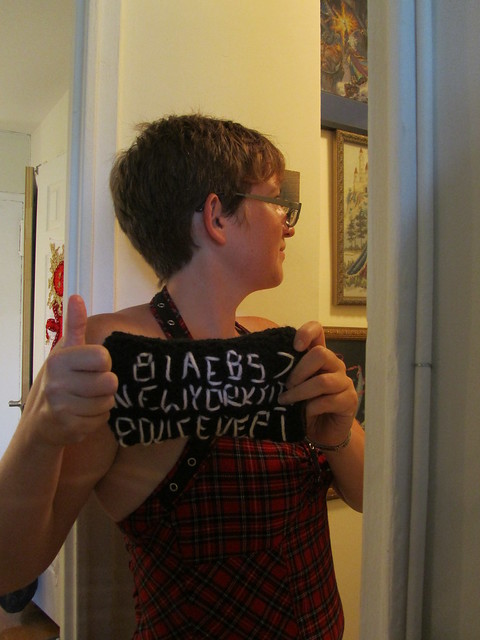
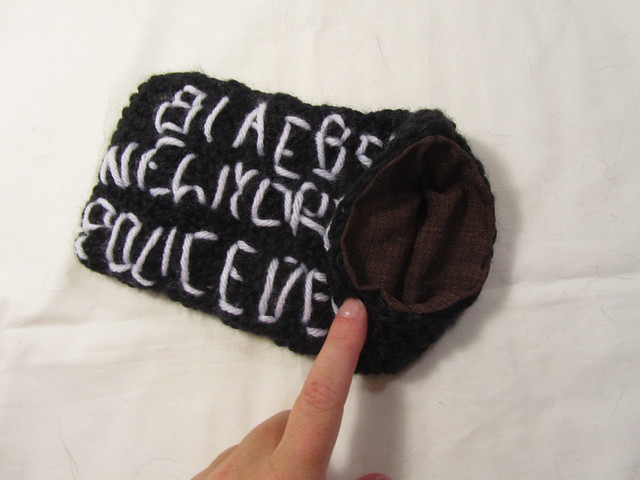
Under Arrest!
I made a little clutch for when I get arrested...


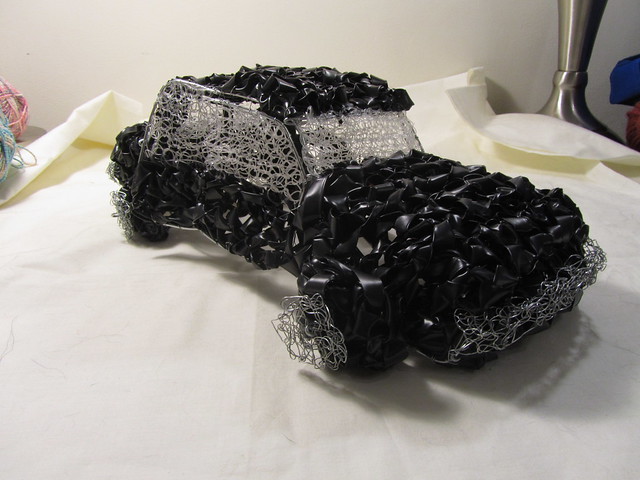
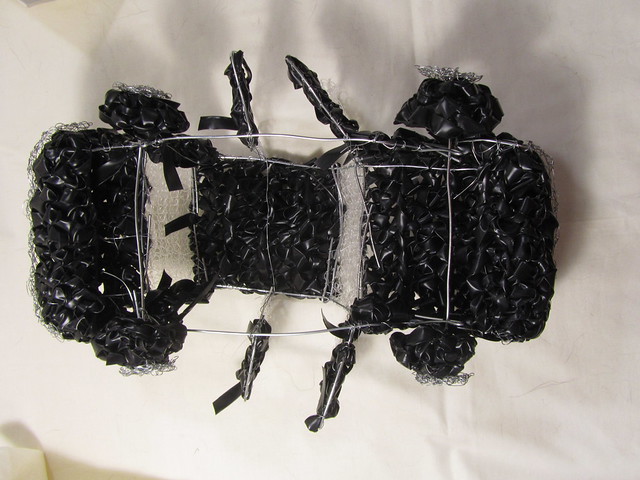
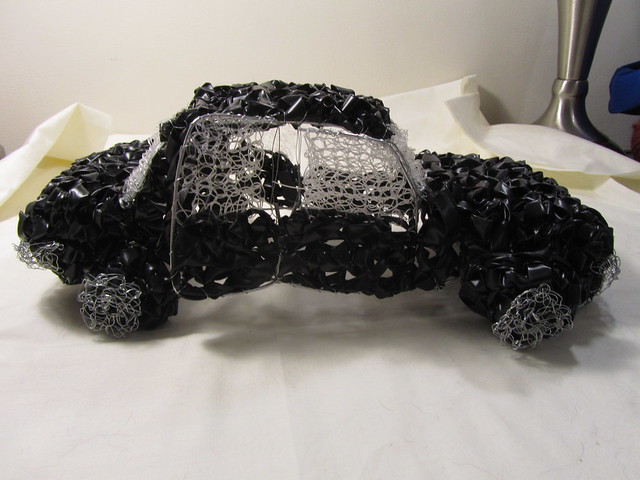
The Impala
My most ambitious FO of the past month, we were challenged in NW to make something out of non-traditional materials, so I used electrical tape, fishing line and wire to design a car.


I'm pretty proud of my little car, the wheels even turn and the doors open!

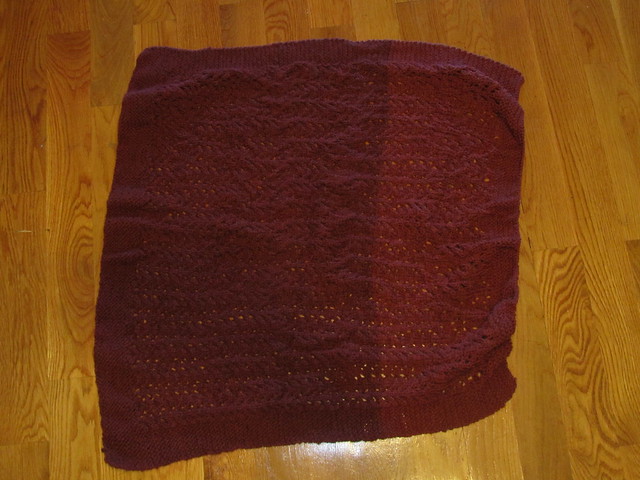
Gull Lace "Shawl"
I finally finished that "shawl"/blanket that I was knitting...

...only to discover that I seriously screwed up on my dye lots, and that my third spool was a flagrantly different shade. Fortunately, it doesn't actually show nearly as bad as in that picture!! I didn't even NOTICE til I took the shot...

Crochet Zouave Jacket
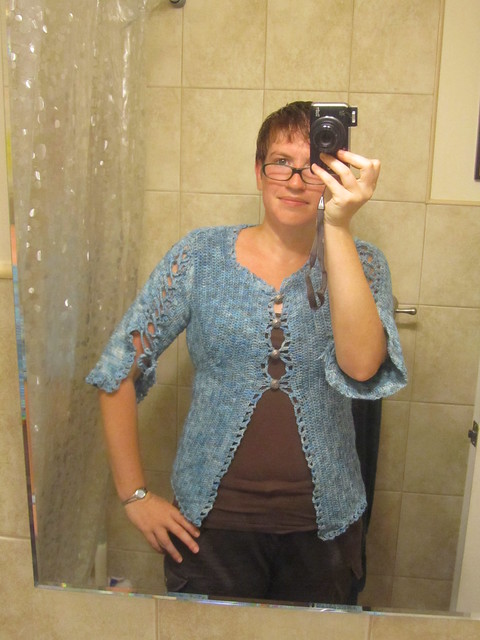
I also finally finished the crocheted zouave jacket I started in the spring.

As a reminder, I was making this based on a pattern from a fall edition of the Godey's Lady's Book published in 1862, but I discovered not long after starting that part of the pattern was actually completely incomprehensible, so I improvised like two thirds of it. It'd been like 4 hours from being finished for three months, so I'm glad to have finally FINISHED it, and I can wear it in the fall. :) The expensive, lovely fingering weight I used is soft as butta'.

Mystery Spot Pillow Case
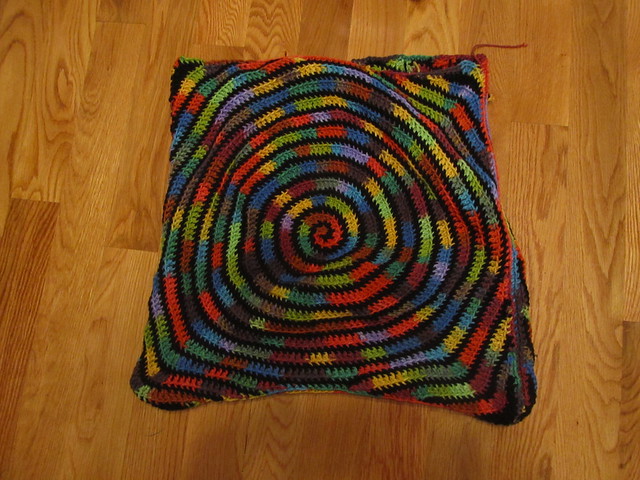
Lastly, I made this pillow case (it's the both on both sides).

I finished this in 6 hours on Wednesday night, I've never crocheted so fast in my life, my hand wasn't hurting but it was getting crazy stiff. Unfortunately, it's much too big for the only pillow I've got, so it'll be a bit before I get a pillow that actually fits it.

Rainforest Worsted Weight
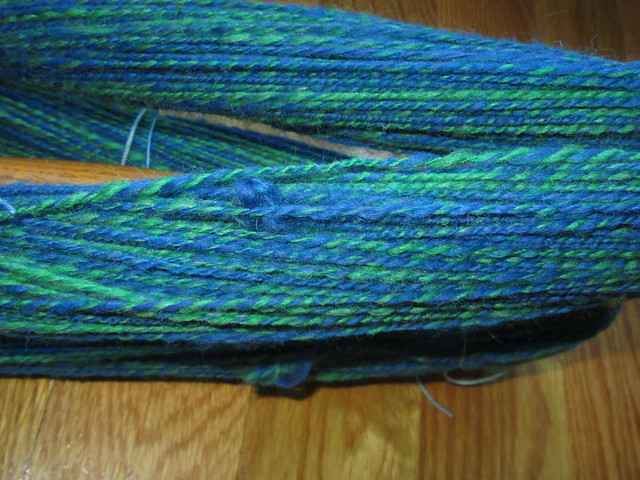
For good measure, I did some spinning! 8 ounces of pure wool, to be exact. I had four ounces each of blue and I had green, so I thought it'd be fun to mix them all together.

I just boiled it today, and once it's done, I think it's screaming "winter hat" - my old hat was made two years ago and has gotten so beat up that it's partly felted, just from all the snow it's been smothered in over the past couple winters.

Phew! It seems like a lot when I stack it all together like this, though in truth I spent most of the month feeling like a total slacker. Funny how perception is like that...

Go see all the awesome! Fiber Arts Friday! FO Friday! Wisdom Begins in Wonder and Tamis Amis and Other Creations blog - be there, or be...square? How about not-crafty?

Tuesday, April 12, 2011

What the Heck is a Sesquicentennial?

Today is the sesquicentennial of the opening salvos at Fort Sumter. Or, in plain English, today is the 150th anniversary of the first shots being fired in the American Civil War. One of the things I don't talk about much - because it's not really pertinent to this crafting blog - is that I'm a huge Civil War buff. As such, I've been eagerly anticipating this anniversary (and am very disappointed that I wasn't able to find the time to go down to Charleston for it) and have been a bit sad that I couldn't figure out some way to babble about the Civil War in my blog a bit. And then I realized I did have a way to babble about it without entirely changing my focus! See, I've been to a lot of sites related to the War, so consider this a photo blog - some of my photography, and a lot of attempting to wax eloquent on the start of the Civil War. Feel free to ignore the prosey parts and enjoy the photographs. ;)

I've always been really interested in US History, and especially the Civil War. I think it's an inevitable side effect of having a father who is a buff (though my brother never developed any interest, so I guess it's not inevitable ;) ). I firmly believe that there's no way to understand where we are without understanding something about where we've been. I'm not talking about learning about unusual people and memorizing dates - neither individuals nor dates mean anything unless the context is known. There are a few defining moments in American history, but I would argue that the Civil War is either the most or the second most significant (I might be prepared to cede the #1 spot to the events surrounding the Revolution). The Civil War is so defining that the entire period before it is called the Antebellum Period (antebellum, as in, before the war). Shelby Foote, one of the great historians of the war, talks about how before the war, people talked about the United States as a plural, as in "The United States are..." But after the war, they talked about the US as a singular: "The United States is..." It forged us from a set of states with individual identity in to a nation that saw itself as unified, even as the divisions that caused the war lingered.

Collar for a slave (National Museum of the Civil War, Harrisburg PA):


A lot of things happened before the Civil War began that led to it's happening, and the war wasn't inevitable. However, fundamentally, the war was about slavery. It was about state rights only to the extent that the southern states denied the right of the Federal Government to interfere with slavery and slave property that was protected in the states. The state rights fallacy is easily dispelled: if the war was about states rights, the south would not have insisted on a fugitive slave law, because they would have had to acknowledge that it was in the rights of the northern states to pass whatever laws they wanted about slavery. But instead, the southern states insisted that the government provided positive, explicit protection for slavery, even as they denied the right of the government to legislate about slavery at all! Contradictory? Perhaps - but it's worth remember that there was never any such thing as a South - just like nowadays, views are nuanced and no one area all felt the same way about things. Leading up to 1860, a series of political and social battles paved the way to the war - battles that had they gone differently, had the combatants made different choices, could have resulted in history going very differently and might not have led to a Civil War. If the Compromise of 1850 doesn't overturn the Missouri Compromise, perhaps there is no war. If John C. Calhoun doesn't change his position on the constitutionality of federal interference with slavery, perhaps their is no war. However, we'll never know. The specific events don't matter so much as the common thread: all of the events involved slavery. But it's more than that: repeatedly during the 1830s, 1840s and 1850s, the actions taken by the South began to make it clear that in order to preserve the servitude of African Americans, they would need to infringe on the rights of whites. And thus it came to be that hundreds of thousands of people in the north who didn't care on bit whether the African Americans were slave or free came to care passionately about the importance of protecting their own freedoms, without interference from what they saw as an elitist slaveocracy. On the other side, the Southerners felt increasingly that they were being manipulated and controlled by a mob of Northern wage slaves and immigrants. Not a recipe for friendship!

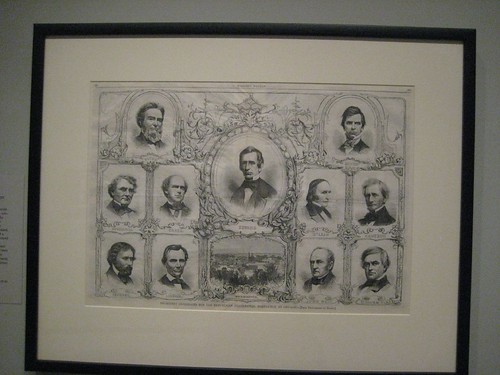
Nominees for the Republican Presidency (Smithsonian American Art Museum and National Portrait Gallery, Washington DC):


These contradictions, and everything that they represented, tore apart the only national party that had survived through to 1860, leading to a contested election with four nominees - a northern Democrat (Stephen Douglas), a southern Democrat (John Breckinridge), a Unionist (...er...something Bell) and a Republican (Abraham Lincoln). Can you even find Lincoln in the image just above? A few months before, he was hardly known at all. It's amazing what little events can shape history! The selection of a compromise candidate led to the election of a Republican even though there were states in the south that didn't cast a single vote for him. Had the Democratic party hadn't split, Stephen Douglas would have been elected, and the Civil War wouldn't have broken out. So why did it happen? After all, Lincoln vowed over and over again that though he personally felt that slavery was a moral wrong and that slaves should be manumitted and sent to Africa. The South didn't believe him, but how could that alone have driven them to secede?

The answer is, it couldn't. However, in the 19th century, elections were about more than just the office in question. Whoever won the election had it within his power to appoint his supporters to political (but not elected) offices. This spoils system was used to reward those who helped get you elected. So, if Joe the butcher, an influential Republican I've just made up, helped get Abraham Lincoln elected by encouraging his township to vote for Lincoln, Joe might be rewarded by being named the postmaster of his town. This is all well and nice when Joe lives in Illinois, but in the South, they knew that the Republican party was the anti-slavery party, and they knew that once Lincoln started appointing Republican's to offices in the South, it would be impossible to prevent the development of a local anti-slavery group. After all, not everyone in the South was pro-slavery, many were just conforming (for any number of reasons not worth going in to). Rather than let this happen, South Carolina worked up the nerve to secede, and was followed soon after by Georgia, Mississippi, Florida, Louisiana, Alabama, and Texas. But that wasn't war, yet.

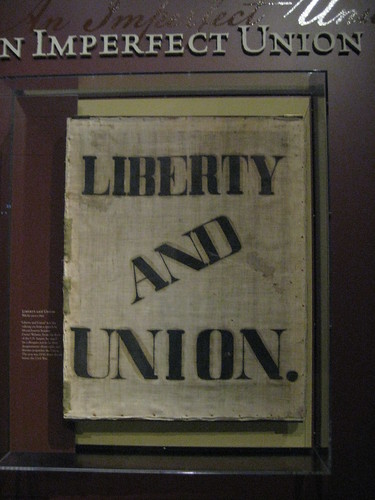
War Banner (Gettysburg National Military Park Museum):


Both sides started to mobilize. Southern states seized formerly national arms depots to arm their revolutionary militias. Forts held by soldiers loyal to the Federal government were ordered to surrender. Some did surrender. Some left. Some decided to join the rebellion. And some held out. A small contingent of troops under a Major Anderson, positioned at a fort called Sumter located at the mouth of Charleston Harbor, decided to stay, and soon became a key to the whole situation. The South Carolinian's insisted that they withdraw. Lincoln told them to stay. The fort was the property of the national government, after all. Militia under P.G.T Beauregard surrounded the fort, and rebellion - now called the Confederate - ships prevented goods from reaching the troops. Anderson considered surrendering. They were running out of food. Lincoln was walking a fine line with his policy. War was looking increasingly inevitable, but if the north were goaded in to firing the first shots it would change the entire international perception of the war. Relations between the two sides broke down rapidly, and finally the Confederates delivered an ultimatum: surrender Sumter by tomorrow or else! And Anderson wrote back and said, well, gimme a couple days, and if we don't get any food or reinforcements, we're going to have to leave! And the Southerners decided that wasn't good enough, so instead of letting Anderson evacuate on April 15th, which he surely would have, they opened fire on April 12th just at first light. The bombardment lasted 36 hours before the Anderson's men surrendered. The only casualty was a horse. As soon as the men of the North - the Union - fired upon the South, North Carolina, Virginia and Tennessee joined the Confederacy, and the course of events was set (at least to the extent that there would certainly be a war). Four years later, 650,000 men north and south would be dead.

So, those first shorts matter! Until that moment, there was still the chance that something else might happen. What if Beauregard's South Carolinians had let Anderson have his couple of days? What if Anderson hadn't bothered to hold Sumter at all? What if Lincoln had ordered the fort evacuated, or ordered it held at all hazards? Part of what makes history so fascinating is that at the moment that the men, women, and children involved made their decisions, they faced numerous options, and made choices for a whole range of reasons, and they didn't know what would happen. We look back, and we say, "that was inevitable," or "that was the critical moment," or "that didn't matter at all," but at the time, the parties involved didn't know which events mattered, they just did the best they could with what they knew and what was at end.

When Abraham Lincoln stood up to take the oath of office in March of 1861, he made an impassioned plea in his inaugural address: "We are not enemies, but friends. We must not be enemies. Though passion may have strained, it must not break our bonds of affection. The mystic chords of memory, stretching from every battle-field, and patriot grave, to every living heart and hearth-stone, all over this broad land, will yet swell the chorus of the Union, when again touched, as surely they will be, by the better angels of our nature." We face a time now with a lot of sectional conflict, and every day I find myself hoping that we too will be guided by the better angels of our nature!

Okay, I'm done babbling history. Here's the plan! I've been setting aside the dates over the next few years when the 150th anniversaries of the major battles will take place. I'll do a full photograph post related to each one, and babble some more about history (sorry, everyone, but it's my blog, ha!). The first big anniversary is Bull Run, on July 21st of this year, but I've never been there before, so no pictures to share (but I'm going for the whole week around the battle). Here are some previews of what else is to come! :)

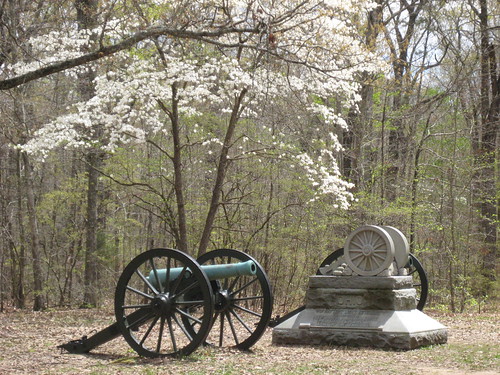
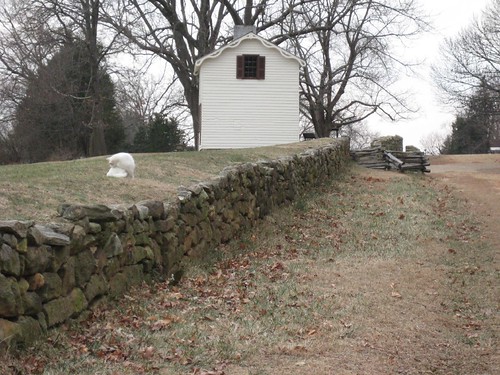
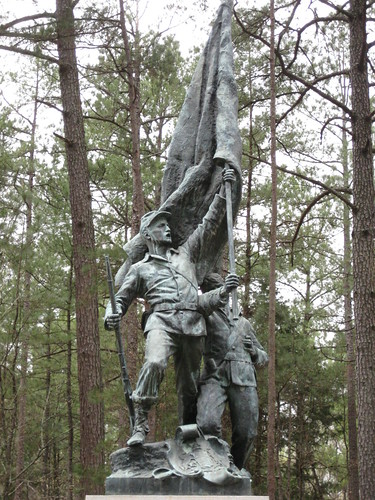
Shiloh (TN. Anniversary will be April 6th and 7th of next year):


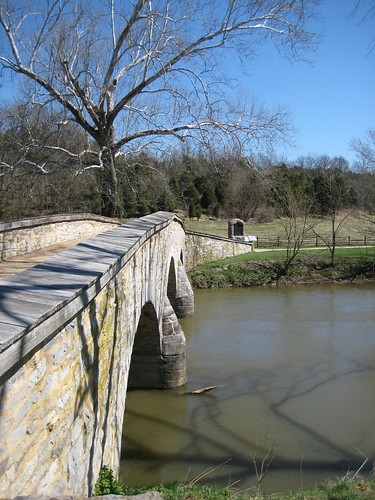
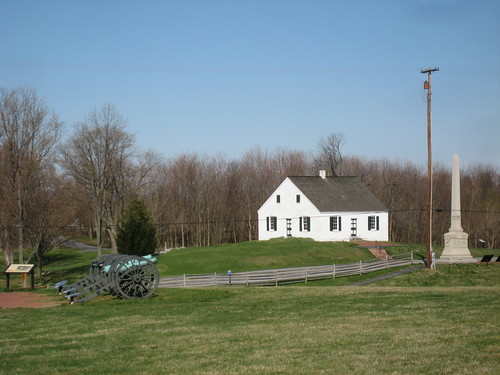
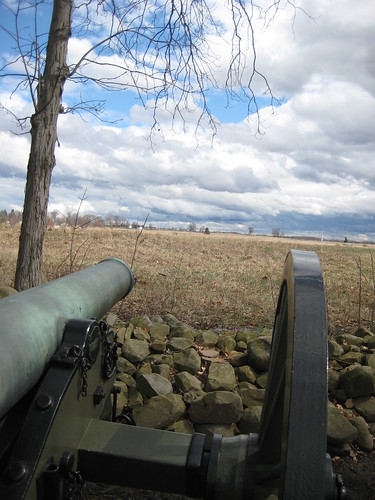
Antietam (MD. Anniversary will be September 17th of next year):


Fredericksburg (VA. Anniversary will be December 11th and 12th of next year):


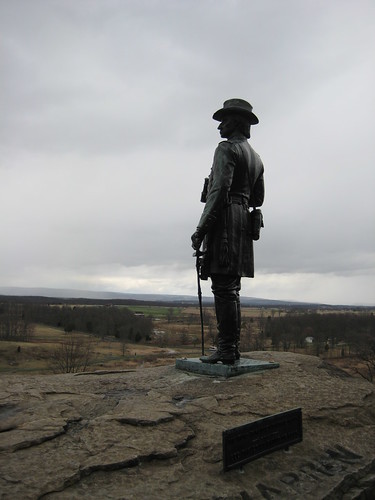
Gettysburg (PA. Anniversary will be on July 1st - 3rd of 2013):


Chickamauga (GA. Anniversary will be September 19th - 20th of 2013):


...and there will be others! (including some I've not been to! And others that I don't seem to have any good photographs of! :) )

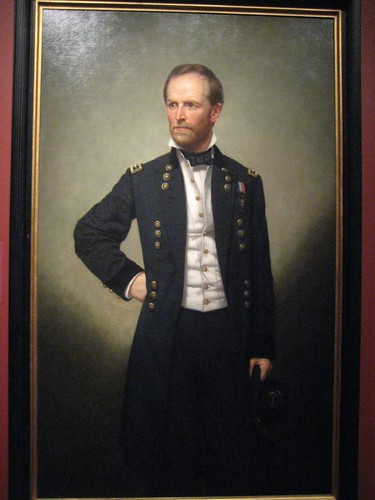
Anyway, I've let this go on long enough, but I can't resist signing off with a shot of my personal hero.

I just can't say I think William T. Sherman is awesome anywhere south of the Mason Dixon line, or I'll face the consequences. :)

Saturday, March 12, 2011

Memories of Japan

I am an avowed Japan-o-phile. I started out by getting interested in anime in 1999, and started studying the language later that same year. In college, I earned one of my undergrad degrees in East Asian Studies with a focus on - surprise - Japan. I'm very interested in Japan, Japanese, their culture, art, history, and - though much less than in the past - I'm still interested in anime and manga. This all culminated in 2007 after I finished grad school, I moved to Tokyo for four months. It's pretty much my second favorite place in the world, after New York City, and I miss it lots.

Thus, it's not a surprise I've been hit pretty hard by the news of the earthquake, tsunami, nuclear power plant problems, and mounting casualty list. The more I read about it, the more I see the pictures of the damage, the more nauseous I feel whenever I think about it. Early today I realized that many people didn't have the personal experiences that I did, and that they were seeing the devastation and that might be the image of Japan that was lodging in their minds. So, to help me process my own feelings, I thought I'd put together a post with some of the best pictures I took while I was there, so that everyone less familiar with the country can get to see a glimpse of the Japan that I know and love. Though a long post, this is only a small selection of the shots I took there - though I was only just getting in to photography then, and I wasn't very good by my current standards. If you'd like to see more, the collection of the images I took on Flickr is here.


Tokyo is a city jammed with people and lit by lights. Unlike many cities (like New York), Tokyo doesn't have one center, it has several, and they're not all close together - many are miles and miles apart. All of these centers have names, and most are united by a loop train called the Yamanote line. This is a shot of Shibuya, where I only visited once.
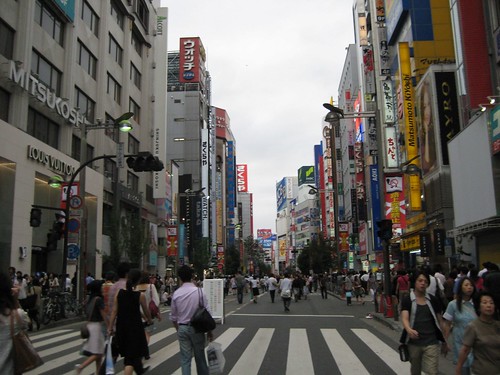

My favorite of the city centers was Shinjuku. On the weekends, they close the streets to traffic, and people fill the streets. Buskers perform (next to a sign that says no buskers allowed!) and frequent all the high-end stores. I went to Shinjuku a lot, for various reasons, like to pay my rent, or to go to the Kinokuniya there which had a good selection of books in English, but I never left without indulging my love of mochicreams, indescribably delicious frozen treats - like mochi but so much better - which I could buy just outside the train station.
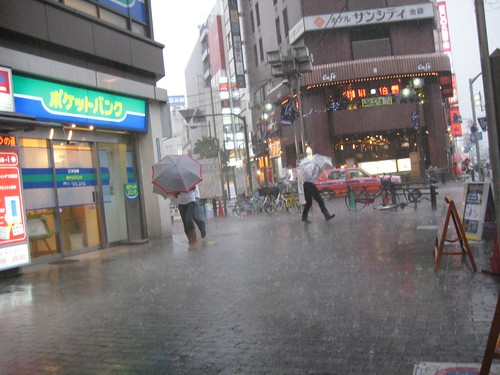

Ikebukuro was another of my favorites. It was home of the greatest used doujinshi store I've ever seen. Like a candy store for self-published manga fans. I ended up getting completely soaked this day (it wasn't raining when I got on the train, so I didn't have an umbrella ;) )
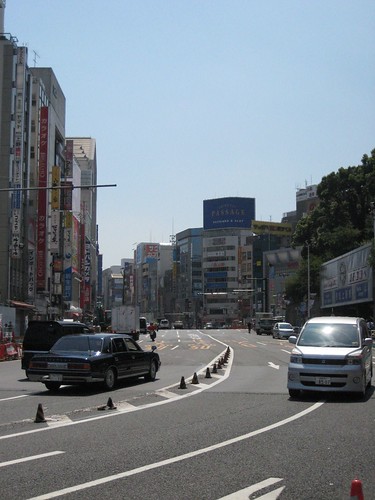

The closest city center to where I lived was Ueno. I took this photo my very first full day in Japan, with the station and Ueno Park on the right, and the shops on the left, and the road leading to Akihabara, which became a major haunt of mine. Any time I wanted to go anywhere, I would walk the mile from my apartment to the Ueno train station. I walked SO MUCH when I was in Tokyo; once, I walked all the way from my apartment to Shinjuku and back - 15 miles in total.
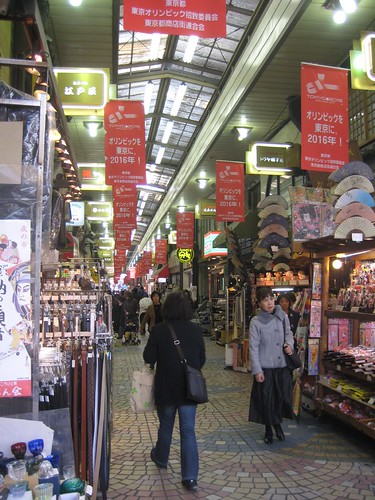

A mile in the other direction from my apartment was an area called Asakusa. Historically, Asakusa was the traditional "low town," where the poor and working classes lived in the 17th, 18th, and 19th century and served the court. At that point in time, as much as a half million people lived in that small area, but it was leveled flat by an earth quake in the late 19th century, then again by the great Kanto earthquake in 1923 which killed more than 100,000 people, and then a third time by the Allies fire-bombing during World War 2, and so it's much less populace now. There are a bunch of streets in Asakusa that are covered and filled with over priced stalls and shops that cater to the tourist trade.
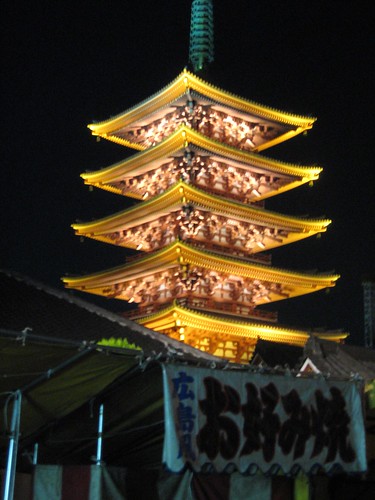

Asakusa is a major tourist destination because of Senso-ji (ji means temple). I would wander that neighborhood a lot, I loved it around there. Like most historical buildings in Tokyo, the original Senso-ji - built in the 8th or 9th century if memory serves - has been destroyed and rebuilt repeatedly. There is only one tori gate on the whole complex that dates from the original construction. The current version, like most "historical" buildings in Tokyo, is a concrete reconstruction meant to stand up to whatever comes.


I lived in a neighborhood called Matsugaya. The streets were quiet, mostly two story one family buildings, some broken in to apartments, others with business in the ground floor.
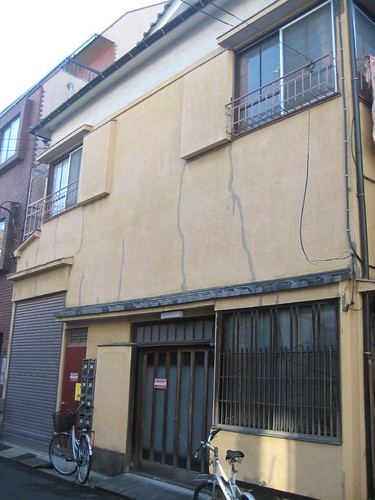

I lived in this one. There was a carpenter across the street, and a man who started work early every morning who would walk down the street singing Japanese opera. Every few days a car came around making a loud announcement that I never quite deciphered, and people would come round in cars and shout that you could buy fresh yakitori or other food from them (but I never actually got any!) At the end of the street was a tori that, when I first arrived, was the only landmark that I was able to use to find my apartment in the maze of similar-looking streets. Tokyo is VERY hard to navigate, and the atlas I bought of the city is the single most useful travel book I've ever had, anywhere. I mean, even more invaluable than a London A - Z. :)
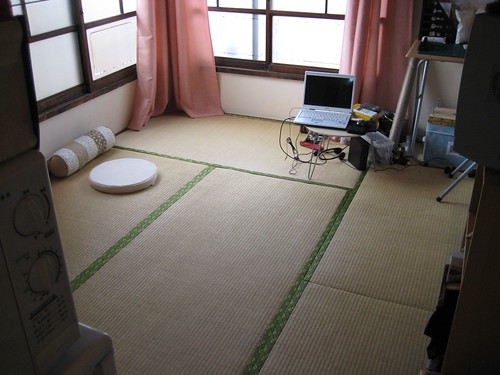

This is my entire apartment. It was around 150 sq. ft. I had to fold the futon up every morning and pull it out every night; sometimes I aired it out the windows, which slid open. The tatami mats smelled like heaven, and I dream even now of having a room in my home where I can just lie on the tatami and soak up the wonderful smell. I never would have thought I could be happy in so little space, but I was. Even in late fall, when my little heater couldn't get my room above 55 degrees at night, I was still happy (and I've had much better cold resistance ever since then ;) ). I was in this apartment when a typhoon hit, and I felt two different earthquakes while I was there (the first time it happened I thought it was my downstairs neighbors doing something best left implied, until I realized how ridiculous that was).


I spent a lot of time just wandering the city, and I grew to adore walking and exploring while I was there. On one of those days, I ended up walking 20 miles, including south down to the Rainbow Bridge. I was terrified of crossing the bridge (it's a phobia of mine), but I mustered my courage. It was worth it - it afforded some gorgeous views of Odaiba, a city center built on reclaimed land and home to an amusement park, a science museum, and loads of other neat stuff. For all that, it was kind of strange though.


The Odaiba ferris wheel is probably the most popular site there. The views when you are up in it are amazing. This is one of the first photographs I ever took with a deliberate eye towards trying to make in all artsy and interesting. :)


Food is one of the things I loved about Japan, and that I miss most. I loved to go was Tsukiji. Every morning at around 5 am, fresh fish are brought in to Tsukiji and served throughout the day to tourists who want to experience the freshest sushi in the world. It's not expensive, and it's absolutely delicious. I've never had sushi that compared. At one of the places I tried, they served me a bowl of Miso that I was shocked to discover these shrimp heads at the bottom.
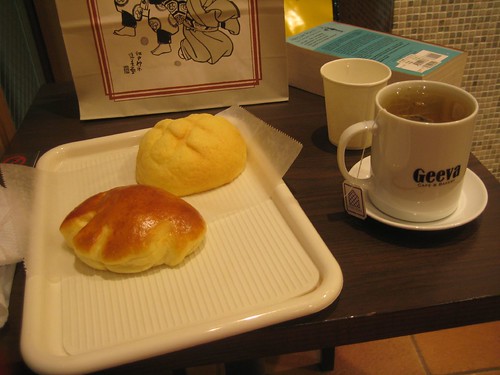

Every two or three days, I would walk to Cafe Geeva to buy fresh bread (in the bag in the back left) and I'd sit and read, drink jasmine tea, and eat Melon Bread of Cream Bread. I've looked and looked but I can find only facsimiles of my favorite foods from Japan. I've found mediocre melon bread in New York, and I found a place with mediocre cream bread the last time I went to Paris, but it's just not the same. And I've never found anything like the regular sliced bread, either - though just Thursday, I was in Flushing and saw some bread that looks suspiciously similar; I can't wait to buy some and try it and find out. I miss the mochicreams so much that when my oldest friend went to Japan last year I told him that all I wanted was for him to some how find a way to bring me mochicreams home. God bless the man, he bought me a dozen mochicreams and a thing of dry ice and carried them home on the plane in an insulated bag. They were just as good as I remembered. The only thing I've found a reasonable version of locally is kitsune udon, which is a noodle soup. Yum...
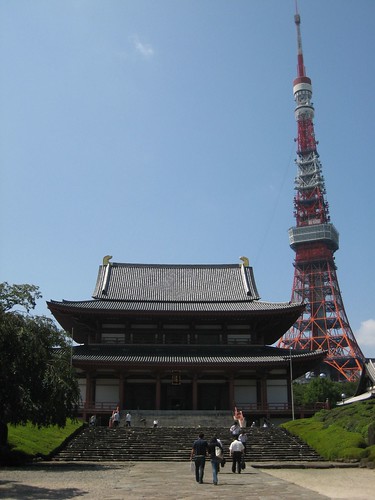

Tokyo is a constant contrast between old and new. I took a lot of shots that highlighted that contrast, but I went with this one because this is a stereotypical shots - one of the most common tourist shots of the entire city, and it's why people visit this temple, just so they can take a picture of both the temple and Tokyo Tower.
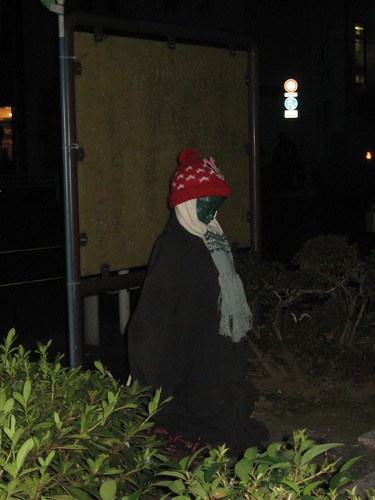

In addition to the big temples, there are little shrines all over this city. Many shrines relate to children, and the dressing of child shrines is considered a duty. I don't know enough about the religion to explain more fully, though.
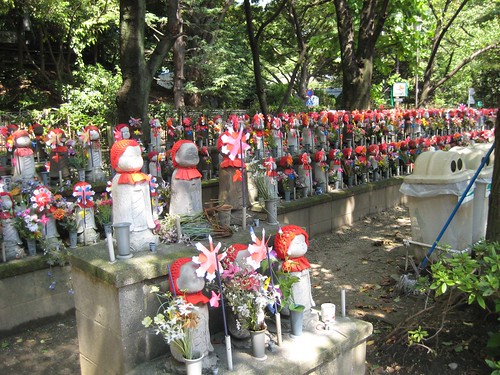

At some temples, there are even entire sections dedicated to the children shrines. These represent the souls of children who died, and every single outfit is hand made, and the flowers are always kept fresh. When the wind blows, all of the pinwheels go round and round.
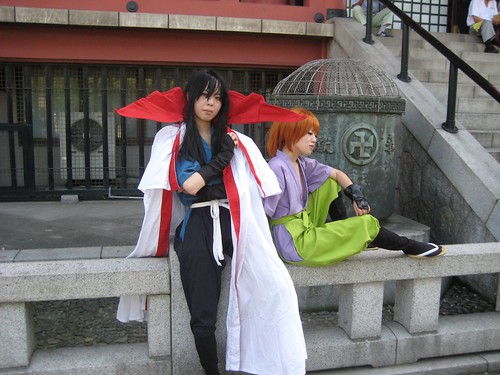

But in the end, it's the people who make Japan. The people who can sit on the seat of an ancient shrine (that's Senso-ji in the back) dressed as Hiko and Kenshin from Rurouni Kenshin, without a qualm. The people who throng through Shibuya, the two million+ people who pass through Shinjuku station every day. It's a vibrant place filled with life.
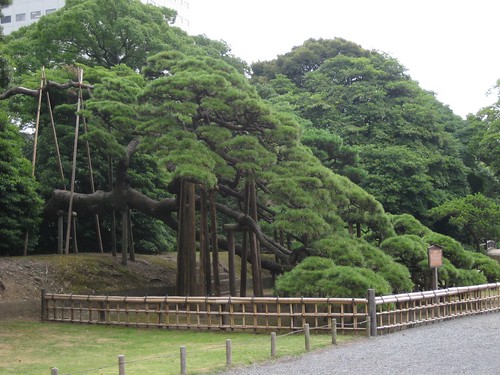

Very little has survived the rounds of destruction that have hit the city. There are virtually no buildings that have, only a few small structures. But at Hama-Rikyu Garden - which used to be a hunting ground for the shoguns - there is a pine tree that has survived for 300 years. And as I think about what's happened there, I just hope that this tree has survived. Because in the end, as long as life has been preserved, there is hope, and a future. Tokyo, and Japan, has rebuilt before, and it will rebuild again.

I know this post got very long, but for anyone who has stuck with me, I hope that these images of Tokyo help to show you another side of this wonderful country, not just the destruction filling the news. Please, consider doing what you can to help. Even a dollar can help to feed or medicate someone who has lost everything. Me, I'll be donating money and food to charity. I wish I could go there to help, but I just can't miss work.
Monday, September 20, 2010

Recovering My Love of Crafting

In my last blog post, I alluded to "an event" that prevented me from completing the cross stitch that I now will theoretically work on during my trip. I thought that I would take a few moments and in brief discuss this event, which took place in March of last year, and basically made me not want to craft for the better part of a year.

March, 2009, I was very busy with work, in the "10 hours a day every day" kind of level. When I would finish in the evening, I was destressing by watching pre-season baseball and working on a cross stitch I had started some time before but never finished. Then, one Friday morning, I woke up with strange bug bites on my arm (that first morning, only the cluster closest to the camera in the linked to image were present). Understandably alarmed, I was unable to find any images on the internet that resembled my bites, so I went to a nearby clinic, which confirmed my worst fear: my apartment had bed bugs!

Now, if you don't know much about this scourge, one of the most important things is that in order to get rid of them, you have to vacuum and/or otherwise clean basically everything you own in preparation for the exterminator coming. As there was absolutely no way I could do this with the amount of work I had to do (all of which had a due date of March 27th or some such), I resolved to keep on as I had been until then. I hadn't even seen a bed bug at this point, so I continued to work hard, continued to walk the dog, continued to watch pre-season baseball, and continued to work on my cross stitch. Then I started to get evidence that the bed bugs were in my couch - bites on my lower back. And that was when the worst happened: when I picked up my cross stitch, I saw my very first bed bug, an adolescent, crawling it's way down the space where the face of the girl I was sewing was supposed to go. I tried to pretend this wasn't a big deal to me, but then the next day I found another, also on my cross stitch. So on the 28th, when I started packing (I had to pack everything I owned in three days) my cross stitch went in a sealed bag in a crate that I was going to not open for a year - in it were all the things that were too fragile to be treated for the bed bugs in the normal ways.

I left for three weeks while my home was treated. While I was away, I still wanted to work on embroidery, so I bought the cross stitch that now is with me on the trip. But it was not to be: in May, the bed bugs came back. With a lot of effort, I took all my fabric, all my yarn, all my embroidery and (along with a lot of the other things I owned) put it all in storage. I did not work on another craft project until I moved in October. I didn't dare! What if it got infested again? What if I gave something infested as a gift? It was too horrifying to imagine.

In the months after that, it was very difficult to regain my love of crafting. Even though I had moved and appeared to bed bug free, I had worked so hard to keep myself from missing it that I found I didn't want to. Also, I knew I had so many materials and such in storage, I didn't want to buy even more! But slowly, surely, the love of crafting started to come, and I started making things regularly again in January.

The story has a happy ending. In May, after the year of quarantine, I got all my belongings out of storage. In the bottom of one crate was the project where I had first seen the bed bug. I was so freaked out by it that I took out of the crate and immediately shoved it in the freezer for two days. But I worked up the nerve to take it out of the freezer again, and then over the next two weeks, I finished it. I don't have pictures yet, but it was this one. My mom has promised to stretch and frame it for me, so I should have it up on the walls sometime after Christmas (she typically gives me my framed cross stitches as Christmas presents). I've now made things with a lot of the materials that were in quarantine, and I've mostly managed to move on from this pretty lousy experience, but there was a little while there when I wondered if I would ever dare to work on a cross stitch again? (the moreso because this was my second cross stitch disaster; the first was when a project I had devoted three months to, a pattern that I loved, was among the items stolen when my car was broken in to - they took pretty much everything in the car, and I was heartbroken - didn't cross stitch again for more than a year). But I always come back to it! :)

Next time, I'll post something more fun, and hopefully with pictures, promise. ;)