Sunday, March 6, 2011

Learning to Spin!

A couple months ago, I posted on the community board in my building, looking for people who might be interested in playing board games (like Settler's of Cataan) with me. A few people responded, one in particular who clearly knew what kind of games I was talking about. She and I have since played a lot of board games, and gotten to know each other, and one of the things we discovered pretty quickly was that we were both Raveler's, though in different areas (and, in fact, neither of us knows the others skill!). She's a spinner (and a knitter), and we'd each talked about teaching the other our craft.

This leads to earlier this week, when she invited me to a Spin In that she was planning to attend, taking place yesterday. The wonderful thing about this March is I'm less busy than I was in Jan and Feb, so I could actually say YES! And commit to going to an all day event. ;) I was excited, too! First, I packed up a project of my own - a plan that will get through a significant amount of my stash yarn, yay! (I'll talk about it more on either WIP Wednesday or FO Friday or both, depending on my progress... ;) ) and then we headed out!

I've wanted to learn to spin for ages, partly cause it's all cool and historical and stuff, but also for a kind of silly reason (that one person I met yesterday could relate to, which made me feel a bit less absurd). You see, I sometimes wonder what would happen if technology went away and we had to manage. I think at that point we'd all have to have some damn useful, semi-primitive skills or else we'd just be a burden on society. Now, I'm not about to go live on a commune without electricity or nothing, but it'd be nice to think I could do something in case such a horrid thing came to pass. But the only really useful non-modern skill I have (other than knowledge and writing...) is that I can sew, knit, and crochet, and I think I'm smart enough that I could improvise the equipment for doing this even if I lost all my needles and hooks and such. What I didn't know how to do, though, is come up with my own raw material. I don't know how to grow cotton, and I couldn't make thread. As such, I've wanted to learn to spin, so that if I could get my hands on a sheep (or alpaca, or any other natural fiber) I might actually have a prayer of being useful to anyone. (of course, I still don't know how to care for a sheep, or how to shear one, but one step at a time, right? It's not the apocalypse yet). How serious am I about this? Not terrible - I mostly just thought learning to spin would be fun - but hey, it never hurts to be prepared, right? Now, perhaps my post-apocalyptic fellow survivors will think I'm useful enough to feed! ;)

My friend has an awesome portable spinning wheel (as did most of the people who were present at the Spin In), but she brought a spindle and some plain, undyed wool for me to use. Now, I'm going to apologize in advance: I had a full tutorial yesterday but I've already forgotten a lot of the vocabulary (generally a weak point of mine) so I may call things the wrong thing, or just not try to name them at all. :) Bear with me! :)

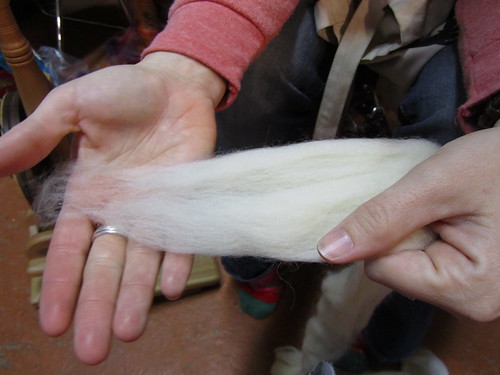
First, she introduced me to the yarn and it's various properties, like how I would have to draw it and how the fibers are held together.

She showed me how I have to figure out how far apart to hold my hands in order to draw the fibers apart, and demoed how once you get good at this, you can do it as fast as you spin! I was impressed, especially once I tried to do it myself. She also told me that until I get to that point, I can pre-draw it, which is what I did most of the rest of the time (I tried the other, way but failed completely, I couldn't seem to get the spindle to spin enough while getting both hands on the yarn to draw it...)

Next step, she showed me how to use the spindle to spin the wool!

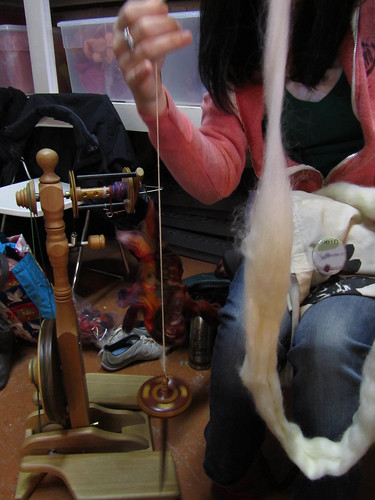
I wasn't too impressed with this at the time, but after I tried it I realized just what a feat it is! Her thread was so nice and even! on the left you can see her wheel and a little of the lovely purple, red, yellow, and other colored fiber that she was spinning... (oh, and her ravelry name ended up in the shot cause she has a button on her bag with it....hmm...I'd better go obscure that...). I mean, there's clearly some trick to getting the spindle spinning just right, so that you can move both hands away, and the amount of spin as compared to the length of the thread you've got dangling and the speed at which you can draw, cause she was doing it all at once, whereas if I moved my hand away from the spindle after setting it going, I inevitable ended up having it start spinning backwards before I'd hardly started drawing. Practice is clearly needed. :)

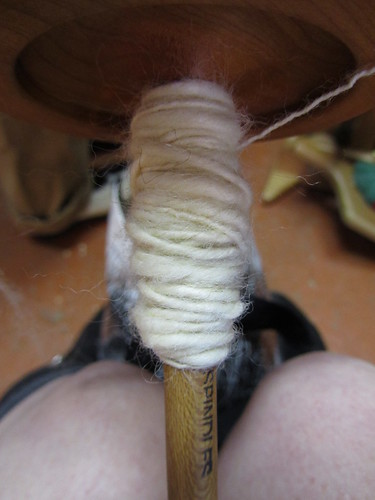
However, despite those challenges I set to it with a will. I apparently semi-independently stumbled onto a "method" by which you hold the spindle between your knees while you draw. I don't know if something this self-evident should really get to be called a technique...

So I would get a whole bunch of fiber ready, and then I'd go ahead and spin it!


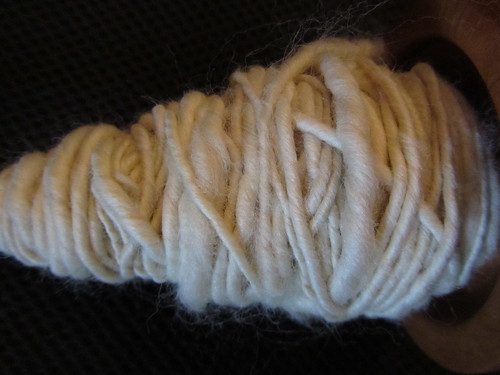
I definitely overspun instead of underspun; my friend said that if I hadn't been spinning it enough, the spindle would have kept dropping. I instead had kinks in the yarn, like over on the top right, from spinning it too much...

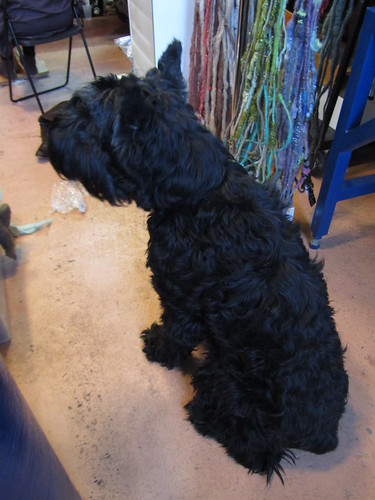
Anyway, these weren't the only pleasures of the day. I got to meet some wonderful people (Ravelers, spinners, knitters, and all!). I didn't take any group shots cause I didn't want to post pictures of people without permission (hence no shots of my friends face) and didn't want to try to get permission from everyone, but I figured that one of our companions didn't need to sign a waiver...

A little of Venus' wonderful "fiber" ended up mixed in with my spindle. :) There was some delicious snacks that people brought, too, whereas I brought my usual reduced cal type sweets - brownies, this time(and made a diabetic very happy, since I always use splenda instead of sugar so she could actually have some!)

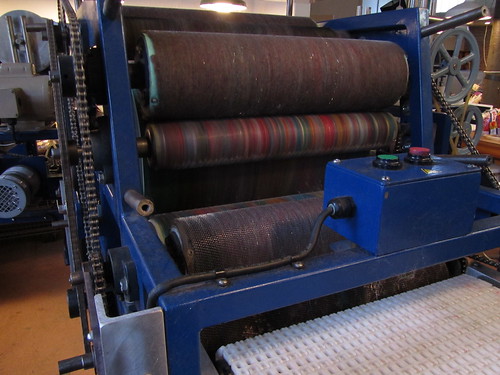
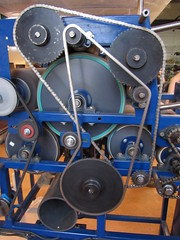
I also got to see the awesome studio where the Spin In was held. Like there was this machine that blended the fibers, it was awesome!


In the end, I got through all of the fiber that my friend brought for me! (I think she said it was close to 2 oz.)


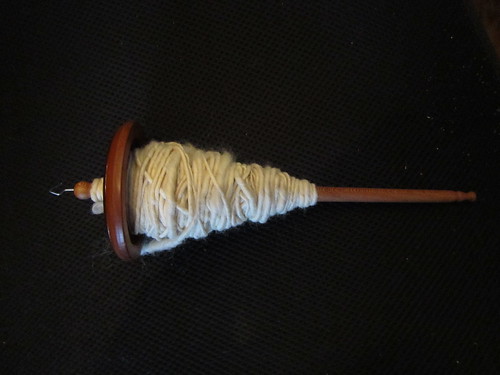
Most of the thick parts are where I had to join to sections together (but not all of them...) and I don't really know what I do next (she mentioned plying, and also getting the fiber to remember the spin, I'll have to ask next time I see her...) but I definitely want to keep trying, it was fun. :) It required a strange combination of concentration and coordination, and I couldn't really muster the mental energy to do anything else while I was spinning, but I bet that gets easier with practice, too. :)

After doing all that spinning, my left hand (which had been spinning the spindle) was aching a bit, so I stopped and switched to the crochet project I brought (okay, first I grazed the goodies table, then I crocheted ;) ). There's another Spin In next month, and I'm definitely looking forward to it! I had fun! (Just what I need - another hobby! ;) )

Friday, March 4, 2011

Meet the Rockin' Rocket Ship and Jose Estrella the Starfish Amigurumis!

Good morning everyone! It's that time again - Finished Object Friday! I've got three FO to share this week, including two brand new, never-before-seen-on-my-blog (and one not seen anywhere!) amigurumi! I'm pretty excited. Also, apologies in advance, this is a pretty long post... :)

Granny Pentagon Lapghan
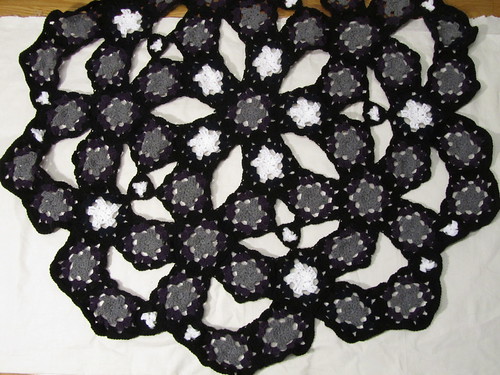
Let's get the less interesting out of the way. Last Wednesday, inspiration struck for another of the Nerd Wars challenges for February. The inspiration: make a granny "square" blanket, but instead of squares, do pentagons, have the centers look like stars, and have the White Star, a ship from Babylon 5, be my inspiration.

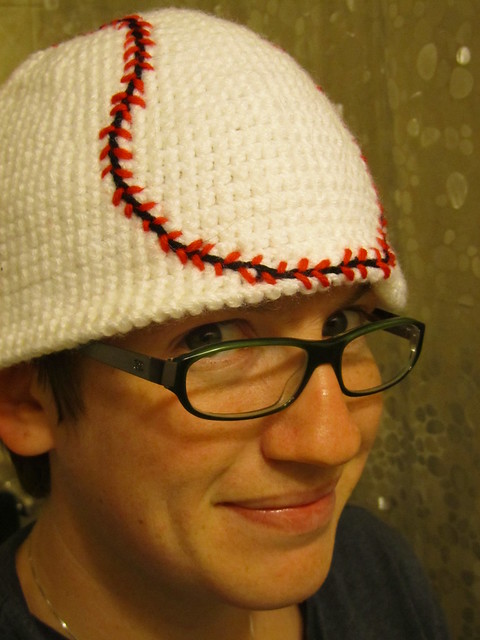
I vaguely had in mind that I'd make a lapghan - baseball season is coming up, and I remember only too well how cold night games get in April, I only had one blanket last year, this year I'll be better prepared, I've made a scarf in Mets colors, a hat embroidered to look like a baseball, and now I've got a second blanket. :) But I didn't really appreciate just how long even a lapghan would take to make. For the challenge, I had to be finished by midnight on 2/28, and I worked in pretty much every moment I had available, and finished at 11 pm that night. :)

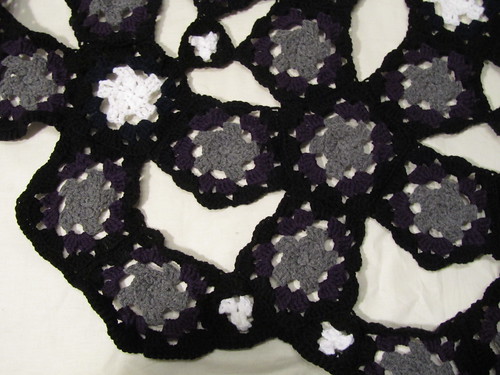
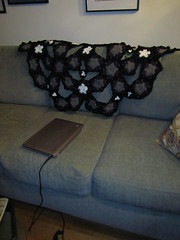
The blanket has 61 pentagons and 15 triangles. Because of the non-symmetrical shape of the pentagons, the triangles proved necessary to make it all fit together.


49 of the pentagons are in gray, purple and black; 10 are in blue, white and black; and the last 2 are in gray, blue and black, because I ran out of purple when I was sooooo close to the end! The challenge I met, by the way, was the "Prime Numbers" Challenge, hence the pentagons - I used five colors, five sided figures, etc.


At the moment, it's living on my couch, where I think it looks quite nice. And thanks to it, I got rid of two entire large skeins of black red heart, left in my stash from a time when I was considerably poorer and had much lower standards (it's not inadequate, I just don't like how rough it is...).

Alright! With that out of the way, the two amigurumi that no one has been able to guess!!

The Rockin' Rocket Ship Amigurumi
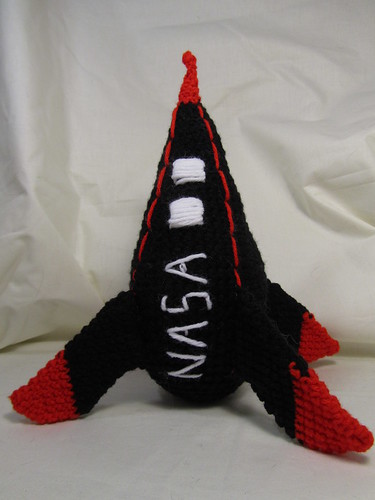
Mid-last month, for another of the Nerd Wars challenges, I had the idea to make a 50s-style rocket ship. In B5, one of my favorite characters, Michael Garibaldi, is very fond of "Duck Dodgers in the 24th 1/2 Century," and so to meet a Nerd Wars "Valentine's Day" Challenge I made him the rocket ship as a "gift." I ended up carrying it to work with me on a day when I was observing an activity at the New York Hall of Science, and randomly enough, the topic that day was rockets (I didn't know ahead of time!) so everyone got a kick out of the first draft (which is posted to Ravelry here). However, if I do say so myself, the second version is much, much more awesome. :)


This is a blast to make. (pun intended. ;) ) I really, really want to make a bunch more of them in different patterns, but I've got so many ideas that it's going to have to wait, for now.


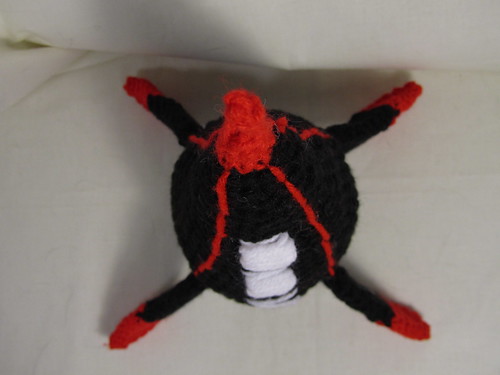
The biggest design challenge was figuring out how to make it stand upright. When I made the first draft I was so worried that it wouldn't work, but it does - the rocket is free standing, and is not leaning against anything in these shots, as you can see! :) More pics on Ravelry.

And lastly, but not leastly, we have...

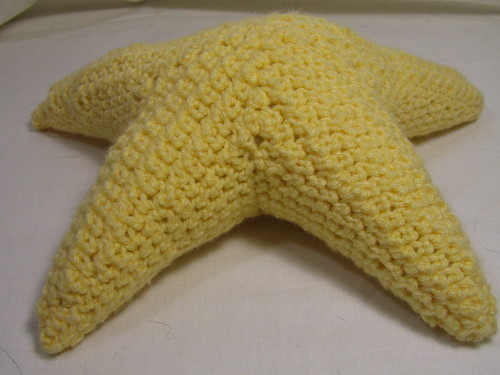
Jose Estrella, Shortstop for the Oceans - a Starfish Amigurumi
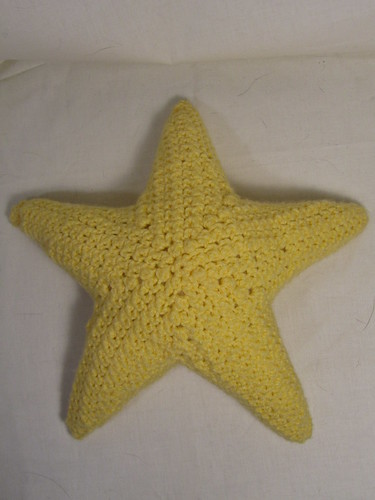
I finished the first draft of Jose Estrella! Like most of the Oceans players, he's inspired by a player on the Mets (Jose Reyes) - but this is the "not in uniform" version. I'll be making the "in uniform" version, hopefully tomorrow. I also have ideas for about 5 other variations on this pattern, so I'll be working on this for the next week or two while I make each type so that I can be sure they all work and I can write the instructions.

To own truth, this is one of those rare times when I get an idea of how to make something and the FO turns out even better than I thought it would. The biggest surprise was that the texture I made for the top meant that the it bulged more than the bottom, which was absolutely perfect for a starfish!


See? I'll be starting a second Jose Estrella tonight, and can't wait. (oh, and for anyone who doesn't know, "estrella" is Spanish for star...). The only real problem with Jose is that he's a little big as compared to the other Oceans players I've made - but since one of the variations I want to develop is easy instructions for how to resize the pattern, I'm not worried at all. :) More pics on Ravelry.

Join in on the fun this FO Friday, and see all the awesome stuff that everyone else has made, over on Tami's Ami Blog! Or, join in in Fiber Arts Friday over at Wonder Begins in Wisdom!

Thursday, March 3, 2011

Spring Coming - Photographs and Early Signs in NYC

Spring and Fall are my favorite seasons, and the first month or so of spring is one of my favorite because I adore spring flowers. We've had a few warm days here in NYC, scattered amongst the cold, and as such I've been starting to take long walks again when I can, and the result is that I've gotten some glimpses that winter isn't forever. (Yes, everyone, it's that time again - a photography post!)

Last Saturday, I had occasion to spend a day at the New York Botanical Gardens. Ostensibly, I was actually working, but that didn't stop me from taking pictures. :) You can see the whole set on Flickr.

I started in the wonderful Conservatory, where of course I expect to see lovely tropical plants in full bloom, and I wasn't disappointed.

There was a powder puff flower...


A bizarre vine called "ceratostema rauhii..."


Some ghostly looking leaves...


A really thorny African cactus called euphorbia didieriodes...


Some Mexican tree ferns that make me wish for a tropical vacation...


One of several bizarre almost plastic-like flowers, this one cavendishia micayensis...


This awesome fuzzy water plant...(can you tell I missed some labels? :) )


...and this. I don't know what it is but I think the shot turned out great. :)


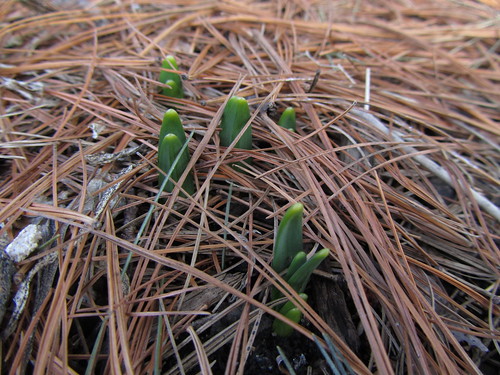
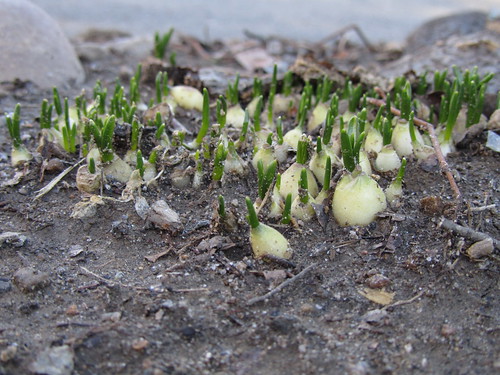
What I didn't expect was to get outside and see, well, any thing worth seeing. But I was in for a surprise. First, I saw these little guys poking up...

...in a spot that I know, from last year, is home to some early-blooming dwarf daffodils.

But I was in for more than just a little green peaking out! There were a few hellebore blooming despite some lingering snow nearby...


...and huge numbers of snowdrops scattered all around!


The witch-hazel was going strong...


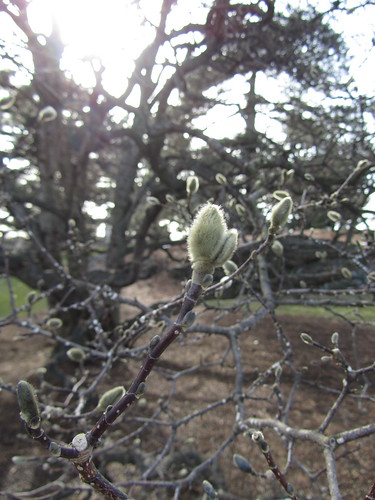
...and the magnolia showed promise for the near future.


It wasn't only in the NYBG that I encountered signs of spring, though! I found these little funny guys a couple days later while walking in my neighborhood!


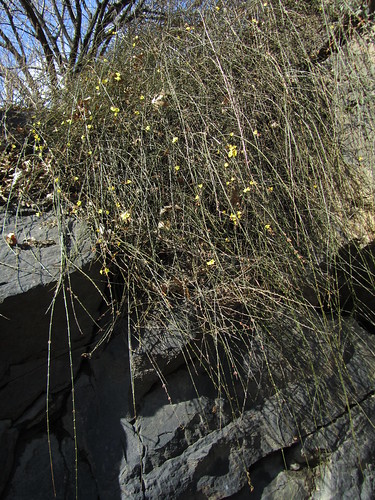
Then yesterday, I walked in Central Park, and I saw some of the other sure signs of spring. There was forsythia...


...but what I really wanted to see were some crocuses. I looked high, I looked low, I looked in sunny spots and shady spots. I went every where I could think of that wasn't too far out of my way where they might be growing, and I saw lots and lots of green sticking out - and even some buds, promise of crocuses within the next few days, but no matter how I searched I couldn't find a bloom in any spot that seemed likely. I'd given up hope, when suddenly, I caught a glimmer of white in a bare patch beneath some trees. I dismissed it as a snowdrop (and I'd already seen enough snowdrops that their magic had worn off) ...when I realized it wasn't the right shape. No, in that unlikely, barren little spot, I found my first two clusters of crocuses for the season. I was so happy that it brought tears to my eyes (I guess I'm really ready for spring. ;) ) I promptly had a 5+ minute photo shoot with the crocuses.


Well, I'm ready for spring. :) Can't wait for the daffodils. I'll leave you all with this, some graffiti I passed during the walk in the park yesterday...

Wednesday, March 2, 2011

Work in Progress Wednesday - 3/1/2011

Ugh, it's too early. But I planned ahead - a day out all day, starting at 5:30 am, means a WIP Wednesday post written Tuesday night (but revised Wednesday morning! ;)
).

I spent most of the past week working on an unexpected project that I had to finish by Monday. It took me five days of four or more hours basically each night, and a sore wrist and elbow, but I finished, and now have a lap blanket that I'll share on FO Friday. :) However, this meant not much in the way of other WIP. That said, I'm almost finished with one of last week's, and I started another that I mentioned two weeks ago, and expect to have both done in the next couple of days. I also put the Man-of-War in for pattern testing, finished the Cowl testing, and published my John Bear amigurumi pattern.

Sooper Sekrit Project
Closer to being done now - had hoped to finish on Tuesday night but I just got too tired.

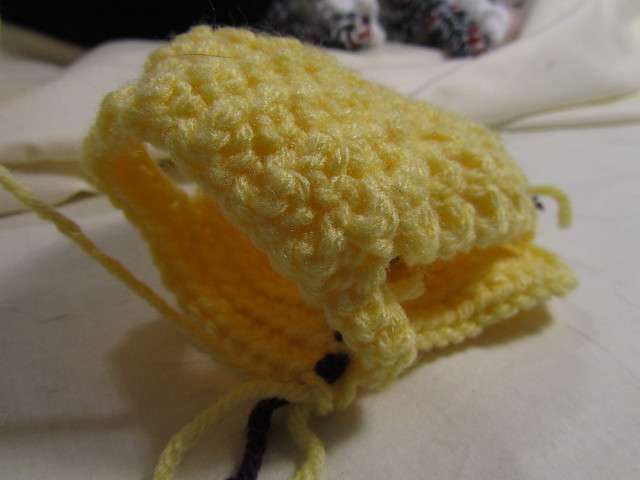
Kinda looks like a fish, don't it? But it's not...hopefully, have it finished on Thursday.

Shortstop for the Oceans
On Monday, I started work on the short stop for the Oceans. I think, given how it looks so far, it's certainly futile to try to keep it a surprise...but now that I've looked at the photos, maybe it's not quite so obvious after all, so I'll leave it as a surprise of sorts for now...


Should have this one done by Friday too, cause it's a perfect commute piece (one ball, one color, one hook, some fiberfill, and no sewing needed), and I have about 4 - 5 hours of commute today.

...and that's all for this week. But then there is the planning. Oh, the planning. :) This includes my intention of yarnbombing...something...using scrap from the past couple months, a plan to make a birthday gift for my grandfather's 93rd birthday (coming up in early April) and maybe something for my dad's 70th (in mid April), a new set of clothing for the male body that I've designed as a doll base (but the clothes I'm thinking of could require that I learn to felt), continued planning for the Ocean's third baseman, still waiting for the materials for the shawl I started last week, considering interesting ways to crochet a pair of wrist cuffs in green...or possible a flower pot cozy, and contemplating what a cute alien equivalent of a cat would look like (keeping in mind the specific adaptations that would have been necessary on the planet where it came from). It seems weird that in a week where I spent this many hours crocheting would have this little to show... :)

Want to see what other awesome stuff people are in the process of making this week? Check out Tami's Ami Blog and visit all of the other blogs participating in this week's WIP Wednesday!

Sunday, February 27, 2011

Evaluation 101: Goal Setting

Welcome to the second of my five posts on how you can better evaluate your business! (it was to be four, but I realized a fifth was essential. ;) ) You can read the first here; it discusses how to construct a logic model. This post DOES build on that one directly, but I will try to make it understandable even if you haven't read the previous, so never fear! This time, we take a look at goals.

What is a Goal?
Many of the things I've seen set as goals by my fellow crafters are excellent in every respect except for one - they are not goals, they are objectives. A goal is a mid-term or long-term outcome that you hope to achieve by engaging in a set of activities, such as those that would go in an "output" section in a logic model. Goals are frequently best described using words (rather than numbers), and should be achievable, specific, measurable, relevant, and based directly on what you are hoping to achieve and what activities you are engaging in as part of your business. I will go in to each of these items in the list below. Here are a few examples of goals - some of which I raided from my own list of goals for 2011 (though many of my goals for 2011 are actually objectives, too ;) ):
"Increase exposure for my business."
"Increase sales for my business."
"Turn a profit."
"Improve my product."
"Enhance my knowledge of my craft."
"Build a Web Presence."

How is a Goal Different from an Objective, a Performance Measure, or a Benchmark?
Now, I want to preface this by saying: I'm not suggesting you all run out and change your goals. If they are working for you, keep them in the form you have (provided they meet the other criteria below and in my next post, anyway ;) ) - in a lot of cases the differences between a goal and an objective, and between both of those and a benchmark, become negligible (and some sources I've seen call objectives goals, and say objective is another term for benchmark, just to make things even more confusing!). It's still worth while to at least understand the difference. Whereas goals are usually general and descriptive, objectives are where the real meat-and-potatoes come in. To take one example from the list above - if the goal is, "Turn a Profit," one objective related to this might be, "increase the range of products that I sell." Other objectives would list other specific, concrete activities that you intend to engage in that you think will enhance your ability to turn a profit. This is different again from a performance measure or benchmark. Performance measures are what you are specifically measuring in order to determine if you are meeting your objective, and they are often also called "benchmarks." Thus, a performance measure related to the "increase the range of products that I sell" might be, "I will publish at least one pattern a month." All goals should have at least one objective associated with them, and all objectives should have at least one performance measure associated with it, in which you demonstrate how you will measure your progress towards meeting the objective. I'll write more about this in a final post which will bring together all of this.

In short, goals are the big-picture aims that show the direction that you want to go. Objectives are how you intend to go about reaching those goals, and the performance measures are how you measure if you've done it.

Formative and Summative Goals
Okay, I'm going to get a little technical here for a moment. Bear with me. :) There are two basic types of evaluation activities. One type assesses the quality and effectiveness of process and addresses questions like:
"Have I done what I planned to do?"
"Have I made my product effectively/efficiently?"
"How can I improve my work process?"
This type of evaluation is called formative evaluation, and is concerned with processes, activities, basically everything that would fall under the "output" category of the logic model that I described on Thursday.

The second type of evaluation address outcomes, and answers questions like,
"Did I make as much money as I wanted to?"
"Did I produce as many units of my product as I wanted to?"
"Did I reach my target in sales/production/etc.?"
This type of evaluation is called summative evaluation, and is concerned with the extent to which specific achievement goals have been met within a pre-specified time frame. It's most closely related to the outcome part of the logic model.

A strong set of goals should include BOTH types, because you cannot really understand one without taking a look at the other. If you only have formative goals (from the above list, "improve my product," "build a web presence" or "enhance my knowledge of my craft" are examples), you don't end up with any idea of what the outcomes of improving your process have been. On the other hand, if you only have summative goals ("turn a profit" or "increase sales for my business" from the above list) then - whether you meet them or not - you don't end up with any clear idea of why you did or didn't hit them. However, by assessing both, and setting goals related to both, you are much more likely to have a clear idea of both how effective the changes you have made are, and why you did or didn't hit your goals for the year.

When you actually get down to it you'll often find that many of your goals have both summative and formative components. And that's fine. For example, "increase exposure for my business" might involve formative objectives ("maintain a blog") and summative objectives ("attend X craft fairs in a year").

Good Goals and Bad Goals
A "good" goal is one that is actually useful to you, providing you with guidance and inspiration and a target to aim for while running your company. A "bad" goal is one that drags you down, can't be achieved, causes you to waste time on non-priority tasks, or one that lacks relevance. When you are writing goals, if you think of a goal and cannot think of any way that you can go about reaching it, then it's probably a bad goal - or maybe you need some time to figure out just what you can do to meet it! For example, if you know that "increase the exposure of my business" is a goal that you want to reach, but you have no idea what activities to engage in to reach it, it's time to do some research and learn what behaviors you can engage in, and once you have, you can start setting objectives - perhaps "advertise on FB" or "create a mailing list" or "attend craft shows" or what not.

It's important to keep in mind that goals are about what you are doing. In the logic model, there is a category on external factors that might influence your output and outcomes. Never set a goal (or objective or performance measure) that only pertains to external factors, unless you are prepared to clearly delineate how you intend to address it. "Increase sales" is only a good goal if you can list activities you will engage in that will bring it about; if you just list "increase sales" as a goal without any associated changes in your behavior, it's a terrible goal, because unless you act, it's highly unlikely that your sales will just go up.

Here's an overview of some of the most important things to keep in mind when writing good goals:

1. Set specific goals.
A list of goals with some specificity will be of the most use to you. "Improve my business" might sound like a good goal, but it's so general that it encompasses pretty much every type of activity that you might engage in as a business owner, while telling you nothing about what you actually intend to do. All of us know some specifics of how we want to improve our businesses, based on our own situations. Those specifics make much better goals. Maybe you have a great product that no one knows about, then you should think about a goal related to advertising or exposure. Or maybe you've got all the attention you could want, but you've got a small product range that your audience is already familiar with - in which case it's time to think about goals related to improving your skills, expanding your range of production, or innovating in to new areas. The more closely aligned your goals are with what you are actually trying to achieve, the easier it will be for you to think of useful objectives (which, remember, describe what activities you'll do to reach your goals).

2. Set relevant goals.
Make sure that your goals matter, and are actually related to what you do. I know this may sound obvious, but I've seen a shocking number of instances in goal lists of goals that are only tangential to the actual activities that are being engaged in. For example, if you primarily intend to engage in activities related to marketing and outreach, setting high goals related to production might not be your best bet. You can't do it all. (that's a mantra, I'll be saying it a lot in these descriptions ;) )

3. Set goals based on your priorities.
Directly following from the previous item on the list, it's critical that you relate your goals to what your actual priorities are. If you don't, you'll just end up running yourself ragged trying to meet goals that have become disconnected from what you are actually trying to achieve. If your priority is to make a little money on the side while raising your family, don't set ambitious goals for profit that mean that you're going to have to work your tail off. If your priority is to become the best at your craft, remember that education and learning take time, so maybe you should scale back on the goals related to production to ensure that you have plenty of time to learn and practice and improve.

4. Set achievable goals.
You cannot do it all. You cannot do it all at once. All good sets of goals should have a time period associated with them (often a year for our business, though in my job it's often 3 or 5 years). Keeping in mind every single type of thing you really have to do in a year, don't set goals that you can't reach. They won't do you a lick of good, and they'll make you feel bad to boot. This is NOT to say that you shouldn't set ambitious goals, and finding the balance can really be hard - but it's critical to be honest with yourself when you set goals. Set the bar high enough that you'll have to work for it, but low enough that you've got a better than 50% chance of getting there, and you'll end up doing your best with a reasonable chance of getting that happy glow from achievement.

5. Set measurable goals.
A goal that you can't tell if you've hit it is of no use what-so-ever. "Get noticed by a publisher" would be an excellent example of this kind of goal. Sure, that'd be awesome, but how on earth are you going to know if you've been "noticed?" It's totally meaningless, for one, and completely impossible to measure, for another. A better goal would be, "be published" - while it's still relates to things partially outside of your control, you can easily delineate a list of objectives (activities) that you'll be able to engage in that will increase the likelihood of this happening.

6. Set goals based on the activities that make up your business.
Setting a goal based on external factors you can't control isn't helpful at all. Building on the last example, "be approached by a publisher this year" is another way to phrase the situation, but depends entirely on external agency - a publisher to find you and want to publish you. Then you are right back where you started - completely unable to assess the extent to which this goal has been met, and at a loss as to how to bring about a situation where a publisher would come to you. In the end, goals are about you and your business and what you do, and how those activities influence others.

7. Goals should not be "yes" or "no" items.
Performance measures and objectives can be yes or no items. You either raise your prices or you don't. You either engage in self-education, or you don't. A goal should never be an activity you either do or don't do. If that's the form your over-arching goals have taken, you're thinking too small and have mixed up the levels. Goals are the big picture things. Raising prices might be one way of turning a profit, but in the end the profit is the goal, the price raising is just an activity you engage in to reach that goal.

8. Good goals aren't the same for everyone!
Don't think your list of goals has to look like every one else's. Maybe, based on your current priorities and situation in life, "scale back my business" is a realistic, reasonable goal. Don't be afraid of that, even though most other business you see will be going in the exact opposite direction. Goals, as I keep saying, are about what you want for your business, based on your own situation, and on what you yourself are doing.

9. Set a limited number of goals.
Repeat it with me: you can't do it all. A good list of goals shouldn't have too many items on it (I'd give a number, but in truth what's reasonable depends on your other obligations - but I'd say if you're hitting over 10 you've probably got too many). If you've de-prioritized something to such an extent that you can only give a very small amount of your time to it, don't make it a goal - since you probably won't be able to do it anyway. Save it for the "long term outcomes" part of your list (remember your logic model!), and keep it for the future, but focus your goals on the short- and medium-term. Give it enough time, and keep chipping away at the things in reach, and the others will eventually come within reach.

10. Don't be afraid to revise your goals.
Things change. Life changes. Situations change. Maybe you got laid off from your day job and need to step it up. Maybe you actually did get discovered by a publisher and went from obscurity to fame over night. Maybe you took stock mid-year and realized that you set the bar way too high - or way too low. Goals aren't set in stone. They are only relevant so long as they are helpful to you, and provide you with support in implementing your business. The instant they cease to be helpful, or become a burden, is the moment when you should consider stepping back and reassessing them. Even a list of goals that starts out "good" can end up being terrible if they become a burden to you.

So. That's a whole, whole lot. I know. You've finished the bulk of it! If you think you've got it, feel free to stop here. However, if you'd like to see it grounded a bit in specifics, I'm going to finish the post off by focusing once again on Widget Co., the hypothetical start-up company that I created for the Logic Model post. Let's take a look again at Widget Co.'s hoped-for short-term and long-term outcomes.
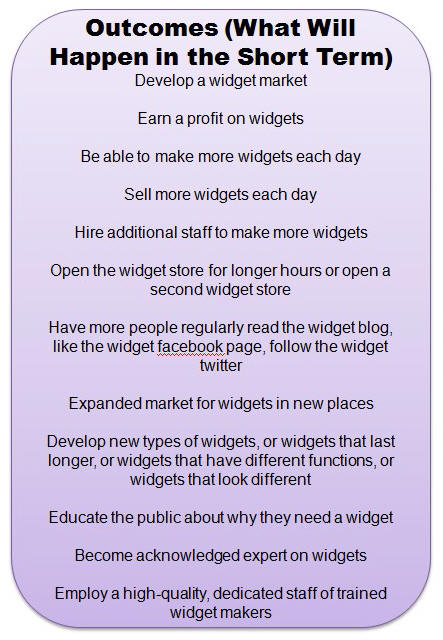

As CEO of Widget Co. I've set my sights on a lot of different areas at once. Some of the things I've listed as outcomes are goals; others are more like objectives - remembering that the distinction is that objectives are activities we engage in, whereas goals are over-arching purposes. And again, these lines get fuzzy, but here's how I would classify the list.
Short Term Outcomes:
1. Develop a widget market: goal. This is broad, but there are a lot of activities that I can engage in to try to reach it. However, narrowing it might be better, as in the below list there end up being many items that are facets of this.
2. Earn a profit on widgets: goal.
3. Be able to make more widgets each day: goal. There are various production-related activities that relate to this.
4. Sell more widgets each day: could be a goal or an objective, but not a very good one. Also, somewhat repetitive with earn a profit - obviously we have to do this to earn a profit.
5. Hire additional staff to make more widgets: objective. This is a way of making more widgets each day.
6. Open the widget store for longer hours or open a second widget store: objective. This is a way of turning a profit and expanding the widget market.
7. Have more people regularly read the widget blog...: objective. This is a way of developing a widget market.
8. Expand market for widgets in new places: goal, but repetitive with item 1.
9. Develop new types of widgets: goal, but one that will require a great deal of thought to figure out how I actually intend to go about doing this.
10. Educate the public about why need a widget: goal, repetitive, a facet of item 1.
11. Become acknowledge expert on widgets: goal, but problematic. How will you know if you are acknowledged? Better to focus on self-education and leave the acknowledgment to posterity.
12. Employ a high-quality, dedicated staff: this is a good, specific goal, much better than item 5, where you just hire them. Repetitive with the other.

Long-Term Outcomes
Pretty much all of the long-term outcomes are problematic to one extent or another. While the first three are perhaps reasonable, and can be measurable, two of the three are really more like objectives to set for success once you've gotten far enough. The fourth (monopolize the widget market) is illegal, and the fifth (world domination) is likely unachievable. While these kinds of ambitions might be our ultimate dreams, there is a big difference between a dream and a goal. If you can't really figure out a reasonable sequence of activities that you can engage in that will enable you to reach the goal, it's probably too big - even for the long term. This isn't to say that you shouldn't have dreams - on the contrary, dream away, please! - but keep in mind that dreams are separate from your business, and you'll be helping yourself out if you keep each step within reach (even if it's distant reach) of your current situation - and then through successive small steps, reach those dreams one step at a time instead of staring at "make millions" on the day you open your doors to the public and wonder how on earth you'll ever do that. Start with "make hundreds," step up to "make thousands," and if you keep it up, who knows, maybe you can get there!

Based on everything that Widget Co. does, and these outcomes, lets set them some reasonable, achievable goals linked to their priorities and the activities that they engage in...
1. Earn a profit on widgets.
2. Improve the production process for widgets.
3. Self-educate on the production, development, types, competition, and other facets of the widget business.
4. Maintain various advertising activities for Widget Co.

Evaluation 101 series:
1. Logic Models
2. Goal Setting
3. Writing Objectives
4. Performance Measures for Dummies
5. Bringing it All Together
Friday, February 25, 2011

Meet Manny Man-O-War, Manager of the Oceans!

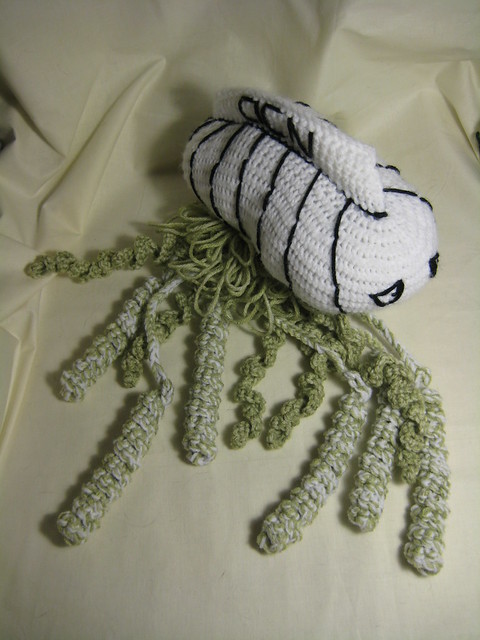
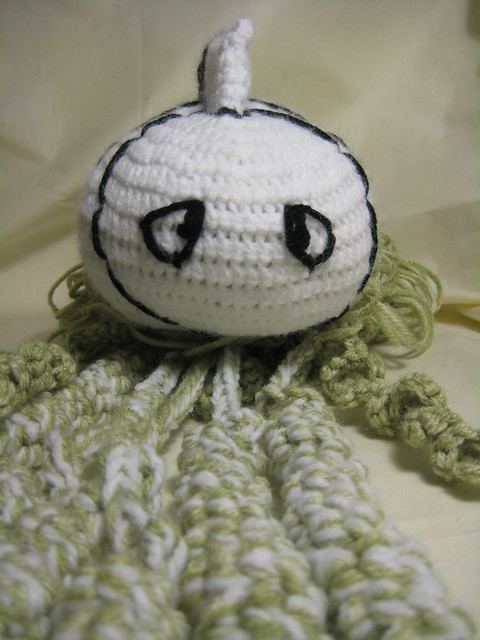
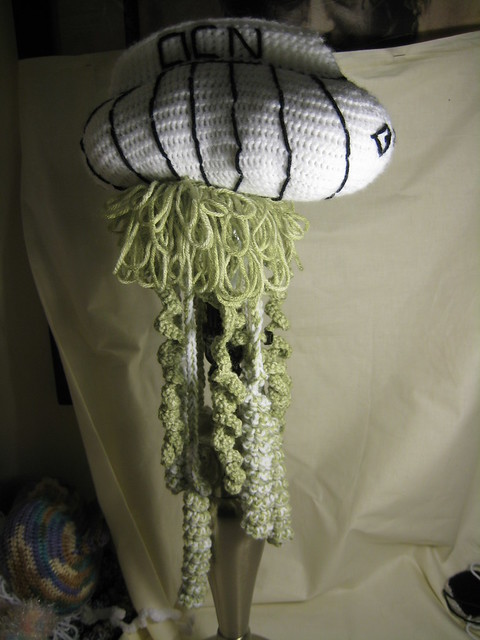
Excellent, exciting news: I've got my camera back from Canon, good as new! So I'll be able to take better pictures of Manny and get ready to test the pattern. But for now, here's Manny Man-O-War, the "in uniform" version of my Portuguese Man of War amigurumi!

This is the second player I've completed of The Oceans, my underwater themed Baseball team - the first is Santana Squid, the Ace Pitcher for the Team.


Manny is one incredibly tough guy, and he doesn't accept anything less than his player's best. They want to stay on his good side, because his stings pack a serious wallop and he's not shy about letting failures feel the rough side of his tongue, and his tentacles. Because of his gelatinous body and is incredibly nasty tentacles, no one could figure out how to get the green uniform on to Manny, but he didn't let that stopped him, he just intimidated a whole lot of photosynthetic algae in to sticking to his tentacles, and he excreted the black pin stripes necessary to complete the look.


Don't let his doe eyes fool you! The other players live in terror of one of his infamous set downs, and he puts Lou Pinella to shame, he fights with the umpires so often! He's been thrown out of games more often than any manager in the history of the Undersea League.


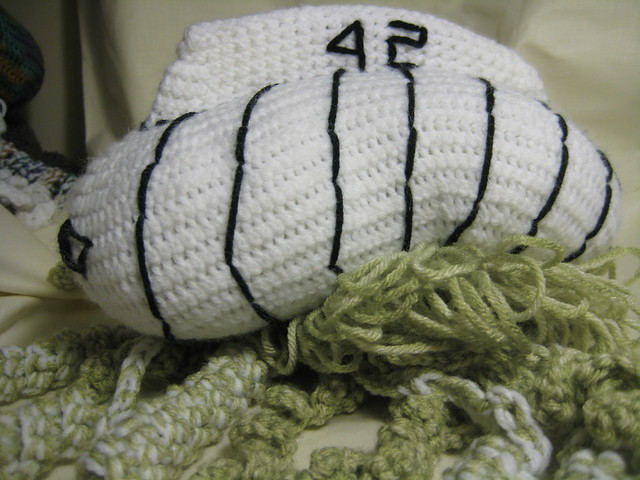
He wears the number 42, because for him - and under his rule, for his players - the Oceans are the Life, the Universe, and Everything.


In the end, though, everyone puts up with him - and many even love him - because all he really wants is for the Oceans to win. He's a tough, mean, confrontational guy, but his heart is in the right place - or at least it would be, if he had a circulatory system.

Join in on the fun this Finished Object Friday over on Tami's Ami Blog! See what everyone else has to show for the week!

Thursday, February 24, 2011

Evaluation 101: Logic Models

Last weeks discussion of how our jobs influenced our crafting business got me thinking, and seeing a recent post over on Fresh Stitches about her progress towards goals for 2011 helped focus an idea I had for a series of four posts about how to effectively evaluate our businesses. The first of these posts (today) will discuss a logic model and how you can construct one. The second will discuss goal setting. The third will be about setting objectives related to the goals that you set. The fourth and last post will be about how to create useful, measurable benchmarks for determining how well you are meeting the objectives.

Just a warning - this is a long, image heavy post (though they'll be small in kb...). However, I think it will be worth it. I hope you all agree!

What is a logic model?
A logic model is a simplified chart that gives you an overview of a program. In my line of work, we are frequently evaluating a program that is designed to, for example, help teachers teach better. This model is just as applicable to business (in fact, it originated in business). Basically, a logic model gives an overview of your business while clearly showing the connections between what you are investing in your business, what outputs you are producing, and what your short term and long term goals are. By putting this in chart form, it helps you see how what you are doing relates to your goals - when you've done it "right," all of our inputs and outputs will relate to your goals - you'll have goals associated with each, and no goals that can't be connected to something you are inputting or producing.

What are the components of a logic model?

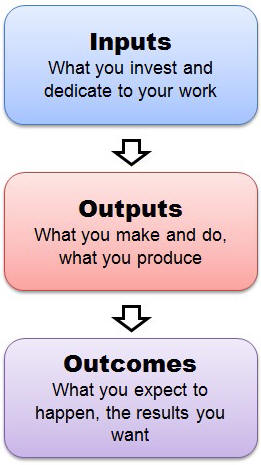
A simple logic model has three components: inputs, outputs and outcomes.

Inputs reflect all of the components that you put in to what you are making. The outputs are all of the activities that you will engage in, and also in many cases who you will be targeting/including in your efforts. Lastly, outcomes are what you expect to have happen. This model is excellent for the sort of simple things that come up in our daily lives all the time. For example, perhaps you come home to the problem that your plants are drooping. At this point, the input would be water and fertilizer. The output would be the activities - measuring out the fertilizer, mixing it with the water, and watering your plants. The expected outcome would be that the plant leaves would no longer droop, and the plant would no longer need water (at least until next time!)

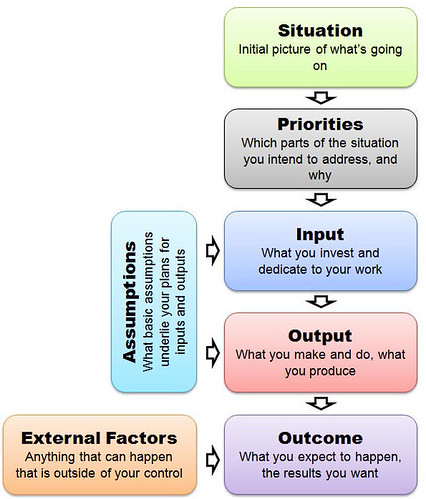
A full logic model has a few other components.

This adds in the situation - what is the initial condition of things at the time that you start pondering all the rest? Priorities - namely, of all of the different aspects of your situation, what are you going to target? It also includes assumptions - what things are you believe to be the case that influence your consideration of inputs and outputs? And finally, external factors are all of those things that can happen that will influence the outcomes. So, to continue the plant example, the situation was that the plant leafs are drooping. To this, you can add in some of your own knowledge - the plants haven't been watered in a week or fertilized in a month. Since it's been so long, you prioritize conducting both activities - watering and fertilizing. After a careful examination of the situation, you proceed with the assumption that water and fertilizer will solve the problem (rather than that the problem is with the type of soil, or the current light source, or the draft by your window - all of which are the potential external factors).

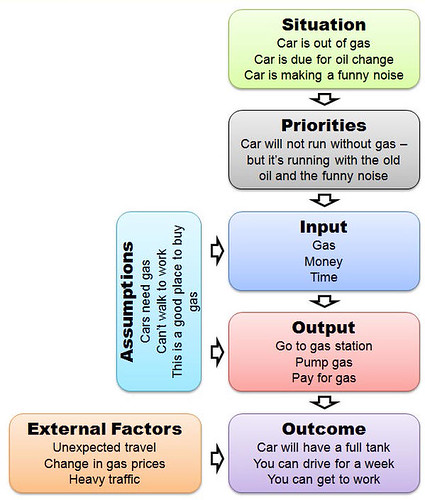
Again - this is still all pretty hypothetical, so I constructed a very simple logic model. You see, the thing is, we actually all use logic models all the time to make decisions, we just don't think about it. The plant example is one like this. I know, as an indoor planter, I go through that all the time, but I never would lay it out like that, I'd just go get the water. Here's another, slightly more complex example.

Again - we all do this automatically when it comes to simple situations. If we feel hungry, we go to the kitchen and get food out of the fridge (unless our priority is our diet!) Indeed, in life this can get very complex - looking at the situation of our life, we determine how to spend our money based on our priorities, and the inputs and outputs are determined by the priorities, situation, and assumptions we make - but sometimes the outcomes don't work out as we expected because of external factors outside of our control! So maybe you put the gas in the car, use up the money, and even though you expect this means you can get to work for the next week, that funny noise you ignored means that the car breaks down, or you hit heavy traffic that eats through the gas, or your office schedules you for a meeting in another state.

So! That's what it looks like when a logic model is simple. Lets make this a little bit more applicable to our craft business. I want to created a hypothetical business, Widget Co., with the idea that I will make - obviously - widgets, a strange item of indeterminate function that I believe everyone needs. I want to make Widget Co. the best widget company in the world!

Why am I using a hypothetical company instead of CCC?
Pretty simple - with a hypothetical, I can control all of the factors, rather than worry about all of the different factors that influence my business - especially, for example, that I work in two different and distinct fields (crochet and photography).

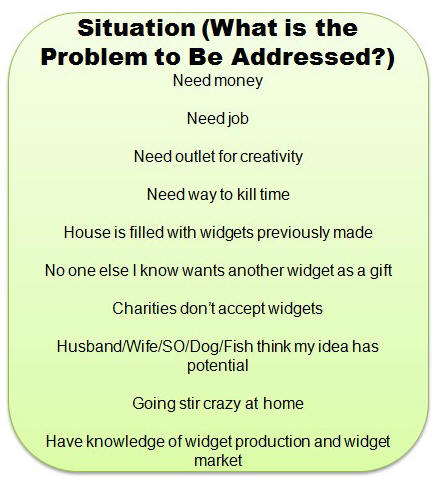
So lets go! Let's say that here's my situation:

Obviously, a real situation will be much more complicated than this. :) But the idea is, identify what it is that you are actually trying to impact by going about whatever endeavor you are going about. When considering the situation, consider: what are the problems? Why are these problems? Who has a stake in the situation? What are the different factors that influence the situation? What are the political, social, environmental, familial, economic, or other factors that influence the situation? Are there activities that you can engage in to learn more about the situation before you proceed? And keep in mind - logic models take time to develop! So, for example, it's taken me about two hours to put together this post - which is nothing! - and thus it's not surprising that it just dawned on me that I should have included "No other companies currently make widgets" to my list of the situation!
But of course, you'll never be able to hit all of the problems with one solution. Instead, prioritize, prioritize, prioritize!

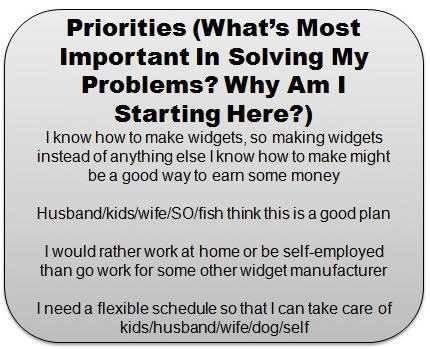
When you set the priorities, consider all of the different factors that relate to why you might make the decision that you make. Who else is affected? Who will be involved in making the decisions? Are there specific criteria for picking your priorities? Why have you picked these priorities? The reasons you have chosen the priorities that you make will impact your desired outcomes. In my example, I've prioritized making money as one thing - so presumably one of my expected outcomes will be profit, or else I've done something wrong! But the list I gave above is just a short sample of the many priorities that you might have.

Next up is the assumptions. Here's only a small selection of the possible list of assumptions that would impact this model:

I could as well indicate many others - but these can be especially hard to identify, precisely because they ARE assumptions. They underlie every decision we make to such an extent that it can be hard to realize that we are even taking them for granted. Talking to others about your business - those who are on the outside and don't know much - can help to single out these assumptions.

Alright. You've got the foundation! So what, exactly, will it take to make widgets?

Here's just a preliminary list of the kinds of inputs that it will take to produce a widget. Note that inputs are always things that are tangible (even if not physical). Time, expertise, money, materials, space - these are inputs. The kinds of things that might be a line item on a budget are inputs.

So, now we've got the raw materials and other bits and pieces that we'll be using. But what is our output - what is our process? - that will be utilizing these inputs?

Ideally, each of these outputs will match to one (or more) of your inputs. So, make widgets connects directly to time, money, and materials. Sell widgets connects directly to space. If you've got an input that doesn't lead to an output, you've got a problem; if you've got an output that doesn't derive to an input, you've got a problem. Don't read my example to closely - I've probably got at least one unpaired, because I put this together so (relatively) quickly, and using a fake example. :)
Another important component of the outputs is who this impacts. Yes, this makes the vocabulary a bit weird - we don't generally think of our audience/participants as being "outputs" but think of it another way - if our product is a widget, than a person who owns a widget is an output - something we have "created" by engaging in this behavior. Thus, we have our stakeholders - the external groups that are influenced by our input of materials and output of widgets.


Ideally, we'd have a different vocab for this - but we don't, so life goes on. :)

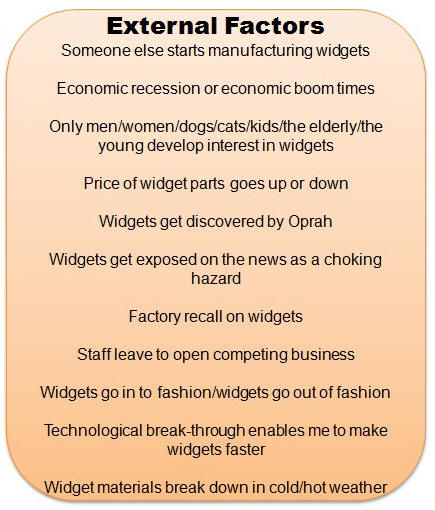
Alright! We're almost ready to take a look at what we expect to have happen. But before we do that, take a step back and consider all of the things other than your own inputs and outputs that might influence your business. Here are a few that I came up with:
Loads more could be added, though, both good and bad!

Lastly, we've got our outcomes. For a real business, you'll generally divide these in to three categories: short term outcomes, middle term outcomes, and long terms incomes. For this example, I've only done short term and long term.

Here, in the short term, is what I am expecting the outcomes to be from my widget business, disregarding the external factors that might end up messing everything up. Short term outcomes should be within reach, reasonable and - and we'll talk about this more tomorrow - measurable.

Long term impacts are where things get ambitious!

However, you'll notice that my long term outcomes for Widget Co. are particularly out there. This is wrong, and I did it wrong on purpose, because it makes an excellent segue into what will be the next post in this series (which probably won't get done tomorrow, just based on how long this one took me I won't have the time - I've been at this for about three hours!!)

Setting outcomes can be hard. The outcomes - both short term and long term - that you set should translate directly in to goals, and the rules that govern what makes a "good" goal are kind of complex but well worth examining, and so I will, in the next post.

Alright, so now we've introduced this, but I bet some of you are asking:
Wow that's a lot of work - why should I bother?
Keep in mind that when you really do this, the different parts all interrelate closely. If you take a step back and list your priorities, then do all the rest and realize that you are engaging in activities that have nothing to do with your priorities, and have other priorities that aren't being met, then you know something new about your business. If you have outcomes that don't link directly to your inputs and outputs, then you need to consider how you can meet that outcome in more detail, and consider how you should change your behavior. If you haven't looked closely at the assumptions that you have made, it can be very difficult (well nigh impossible!) to isolate what has gone wrong when things don't go quite as you expect. I could continue to list examples.

I'm sure that all of us have done something like this, to a lesser or greater extent, for our business. We can't continue to produce our outputs if we don't know what our inputs are! But, for example, I think a lot of us overlook the importance of the time we spent on the internet as a marketing tool - getting the word out about our businesses IS an essential part of our business. When you actually do one, consider listing the items in each category by importance - that'll help you figure out how best to divide your time (which is an input that is ultimately completely limited by the number of hours in the day! ;) ) In short, this is the kind of activity that you'll get out as much as you put it.

Now, to tell you honestly - I've not yet done a logic model for my own business. :) But now that I've really reminded myself of just how useful they can be, I'm definitely going to.

And don't forget - this isn't set in stone! It changes over time, just as our priorities and hoped-for outcomes, input skills and output products, do.

If you want to learn more about logic models, this is a very helpful site. The Teaching and Training guide listed there helped remind me of all the different bits and pieces to include in this post. :)

Until then - I hope this is helpful! :)

Evaluation 101 series:
1. Logic Models
2. Goal Setting
3. Writing Objectives
4. Performance Measures for Dummies
5. Bringing it All Together